
Views: 0 Author: Site Editor Publish Time: 2026-11-14 Origin: Site


A bustling automotive manufacturing line suddenly comes to a grinding halt. Robotic arms freeze mid-motion. SCADA monitoring screens flash red. The root cause is not a mechanical failure. It is not a sudden power outage. Instead, a recent machine firmware update failed to execute properly. Unlike standard consumer electronics, an embedded computing system operates in harsh, mission-critical environments. Unexpected downtime here costs thousands of dollars per minute. It disrupts global supply chains and introduces severe safety hazards.
Recent industry shifts highlight a massive transition toward edge-heavy architectures. As operational technology networks converge with IT systems, strict cybersecurity frameworks like IEC 62443 are becoming mandatory baseline standards. Field engineers are witnessing a sharp increase in targeted threats on edge nodes, pushing the industry toward Zero Trust security models. Consequently, managing the low-level code that controls specialized hardware is no longer just a routine technical task. It is a fundamental business imperative. The definitive solution to mitigating these operational risks lies in rigorous firmware version control. By systematically managing, tracking, and deploying changes to the foundational software running on these devices, organizations ensure their infrastructure remains stable, secure, and fully operational through countless software update cycles.
This comprehensive guide breaks down exactly how firmware version control functions in modern automation. We will explore the technical processes involved in safe updates, outline best practices for Original Equipment Manufacturers, and explain how choosing the right hardware infrastructure ensures long-term system resilience.
Key Takeaways
Firmware acts as the critical bridge: It connects the raw physical hardware to higher-level software applications, making strict versioning essential for stable interactions with physical components like sensors, stepper motors, and status LEDs.
Semantic versioning is the industry standard: Utilizing systematic numbering formats ensures that development engineers and automated deployment servers precisely identify which iteration is currently active on a specific device.
Dual-bank partitioning prevents catastrophic bricking: Modern industrial computing systems leverage split memory architectures to safely test a newly downloaded payload while retaining the previous version as a reliable, automatic fallback.
Remote updates demand uncompromising security: Cryptographic signatures, secure bootloaders, and TLS encryption are mandatory measures when pushing remote patches over a network.
Hardware infrastructure dictates software success: Successful management relies heavily on robust physical design, including fanless architectures, dedicated GPIO, and hardware watchdog timers to support complex update procedures safely.
To fully grasp the intricate mechanics of version control, one must first understand the core component being managed. In empirical terms, firmware is the foundational, low-level software permanently programmed into the read-only memory, EEPROM, or flash memory of a hardware device. It provides the essential instruction set that allows the physical silicon to power on, initialize memory blocks, and communicate seamlessly with other internal and external peripherals.
It is crucial to clearly distinguish firmware from standard embedded software. They occupy entirely different layers of the technology stack. Firmware operates at the bare-metal level, handling the direct Hardware Abstraction Layer and basic device control. This includes micro-level tasks such as managing CPU registers, regulating thermal power distribution, and reading General-Purpose Input/Output pins during the initial boot sequence. In contrast, embedded software typically sits above this foundational layer, managing higher-level data processing algorithms, complex network protocols, or graphical user interfaces.
Consequently, the architectural design of this low-level code directly influences the overall functionality, thermal efficiency, and real-time processing capabilities of a mini industrial computer. Because firmware operates so intimately with physical components, any logical flaw or memory leak at this tier can lead to immediate hardware malfunction. Therefore, maintaining strict, documented control over its various iterations is an absolute necessity for hardware engineering teams.
In heavy industrial environments, the risks associated with unmanaged or poorly executed code revisions are profoundly magnified. Deploying an untested or incompatible payload can easily brick a controller on an offshore oil rig, a smart grid substation, or an automated guided vehicle in a logistics warehouse. This renders the equipment completely inoperable. Version control acts as the primary risk mitigation strategy against these costly and potentially dangerous failures by ensuring only validated code reaches production environments.
Furthermore, version control provides essential traceability and auditing capabilities. It creates a definitive, immutable historical paper trail of all software modifications. If an automated machine malfunctions, diagnostic engineers need absolute certainty regarding what code was executing at that precise timestamp. Without a strict versioning framework, identifying the root cause of a mechanical fault becomes an inefficient guessing game.
For fleet managers overseeing hundreds of industrial PC units globally, this system prevents configuration drift. Configuration drift is a dangerous scenario where identical machines end up running slightly different, undocumented software variations. This inevitably leads to unpredictable operational behaviors across the manufacturing floor.
To implement a successful version management strategy, engineering teams rely on highly specific methodologies and software tools to maintain order over constant code iterations.
Semantic Versioning
Semantic versioning is the globally recognized industry standard for numbering software releases. It follows a highly structured Major, Minor, and Patch format. This instantly communicates the exact nature and potential impact of the update to both developers and automated deployment servers.
Major Release: Triggered by breaking changes, incompatible API shifts, or massive architectural overhauls. This carries a high risk and often requires extensive validation or potential physical hardware adjustments.
Minor Release: Triggered by the addition of new, backward-compatible functionality. It carries moderate risk, allowing devices to gain new features without breaking existing operational logic.
Patch Release: Reserved for minor bug fixes, routine security patches, and background optimizations. These are designed to be highly stable and low-risk.
Version Control Repositories
In embedded development environments, engineers utilize sophisticated repository tools like Git or Subversion to track every single modification made to the source code line by line. Developers employ a technique called branching to safely write and test new features in isolated sandbox environments without affecting the stable, main production codebase. Once a feature is rigorously tested, it is merged back into the main branch. Engineers then use tagging to mark specific commits as official release candidates, permanently linking a version number to an exact snapshot of the code.
Hardware-Software Coupling
A unique challenge in embedded systems is that firmware versions are intricately tied to specific physical hardware revisions. A payload optimized for Hardware Revision A might attempt to access memory addresses or voltage regulations that have been altered in Hardware Revision B, potentially frying the circuits. Therefore, version control matrices must explicitly document hardware compatibility dependencies, ensuring that a specific software iteration is only deployed to physically capable devices.
Transitioning a newly compiled firmware version from a developer repository to an active physical machine requires a highly orchestrated, multi-step deployment pipeline to ensure zero data corruption.
The Role of the Bootloader
The unsung hero of the update process is the bootloader. This small, highly protected piece of code executes the moment the hardware receives power, acting as the primary traffic controller. Before loading the main operating system or application firmware, the bootloader checks specific system status flags. If it detects that a new firmware payload is waiting in memory, it halts the normal boot sequence, verifies the cryptographic integrity of the new file, and initiates the dedicated update mode to unpack the payload.
Specifically, the industry has moved away from manual updates toward automated remote deployments. Below is a breakdown of how these methodologies compare in a real-world industrial setting.
Deployment Method | Downtime Risk | Scalability | Security Mechanism |
|---|---|---|---|
Manual USB or Serial Flashing | High - Requires machine shutdown | Extremely Low | Air-gapped physical access |
Secure Over-The-Air Updates | Low - Background downloading | High - Fleet-wide deployment | TLS encryption and digital signatures |
A/B Partitioning and Rollback Mechanisms
To guarantee safety during remote deployments, modern industrial systems employ an A/B partitioning methodology. The device flash memory is physically divided into two distinct, identical sectors. While the system actively runs and controls machinery using Partition A, the new firmware is downloaded and written entirely in the background to Partition B. Upon the next scheduled reboot, the bootloader is instructed to launch from Partition B. If it fails to boot correctly due to file corruption or incompatibility, a hardware watchdog timer times out. This triggers an automatic hard reboot, forcing the system to roll back to the known-good Partition A, thereby preventing device failure without human intervention.
For equipment manufacturers and system integrators, establishing a robust version management protocol is crucial for maintaining customer trust, ensuring ongoing system integrity, and minimizing expensive warranty claims.
Automated Validation Pipelines
Advanced embedded engineering teams employ automated Continuous Integration and Continuous Deployment pipelines to enforce strict quality assurance. In this workflow, every time a developer commits new code to the repository, automated servers instantly compile the firmware. They run a battery of unit tests alongside Hardware-in-the-Loop simulations. This automated validation ensures that a new commit does not break existing functionality or introduce subtle memory leaks before the code is ever approved for physical deployment.
Cryptographic Signatures and Security
As factory networks become increasingly connected to the cloud, the risk of cyberattacks rises exponentially. Consequently, firmware payloads must always be encrypted and digitally signed using asymmetric cryptography like RSA or ECC keys. When a remote update is initiated, the bootloader verifies this cryptographic signature against a known public key stored securely on the device. If the signature is missing, invalid, or tampered with, the installation is instantly aborted. This prevents malicious actors from injecting ransomware into the operational technology layer.
Comprehensive Release Notes
Thorough documentation is a frequently overlooked but vital component of version control. Factory operators and maintenance teams require absolute transparency regarding system changes. Comprehensive release notes must accompany every version increment, detailing exactly which vulnerabilities were patched, what specific operational bugs were resolved, and how newly introduced features might impact existing machine workflows.
The foundational architecture of the code heavily dictates how smoothly version updates can be managed over the multi-year lifecycle of industrial hardware.
A well-architected codebase relies heavily on a robust Hardware Abstraction Layer. This layer acts as an intermediary interface, separating the core application logic from the hardware-specific silicon drivers. By utilizing a modular architecture, engineers can write the core application firmware once. If a manufacturer needs to switch to a different microprocessor due to global supply chain shortages, they only need to rewrite the specific drivers rather than overhauling the entire firmware codebase. This modularity drastically reduces the risk and engineering overhead associated with cross-platform version updates.
In addition, timing is everything in industrial automation. Firmware must be meticulously optimized to handle real-time events deterministically. If a sensor detects a physical blockage on a conveyor belt, the firmware interrupt service routine must instantly pause background tasks, such as downloading an update, and trigger the mechanical braking system in microseconds. Code designed for a Real-Time Operating System ensures that these critical tasks are prioritized correctly. Version updates must be carefully profiled to guarantee they do not inadvertently introduce latency into these critical pathways.
Ultimately, software version control processes are only as reliable as the physical hardware executing them. Bottom-of-funnel integration planning requires decision-makers to evaluate computing platforms based on their inherent ability to support secure, fail-safe management procedures in challenging environments.
When evaluating hardware for deployment, engineers must prioritize specific features that facilitate stable remote updates. Hardware watchdog timers are absolutely non-negotiable. They act as the ultimate failsafe, automatically rebooting the system if a firmware process hangs or enters an infinite loop during an update. Dual LAN ports provide crucial network redundancy. If one network switch fails during a critical download, the secondary connection seamlessly takes over. Robust I/O interfaces, such as isolated 8-Bit GPIO and up to 4 COM ports, ensure the hardware physically supports complex, multi-layered instructions without electrical interference.
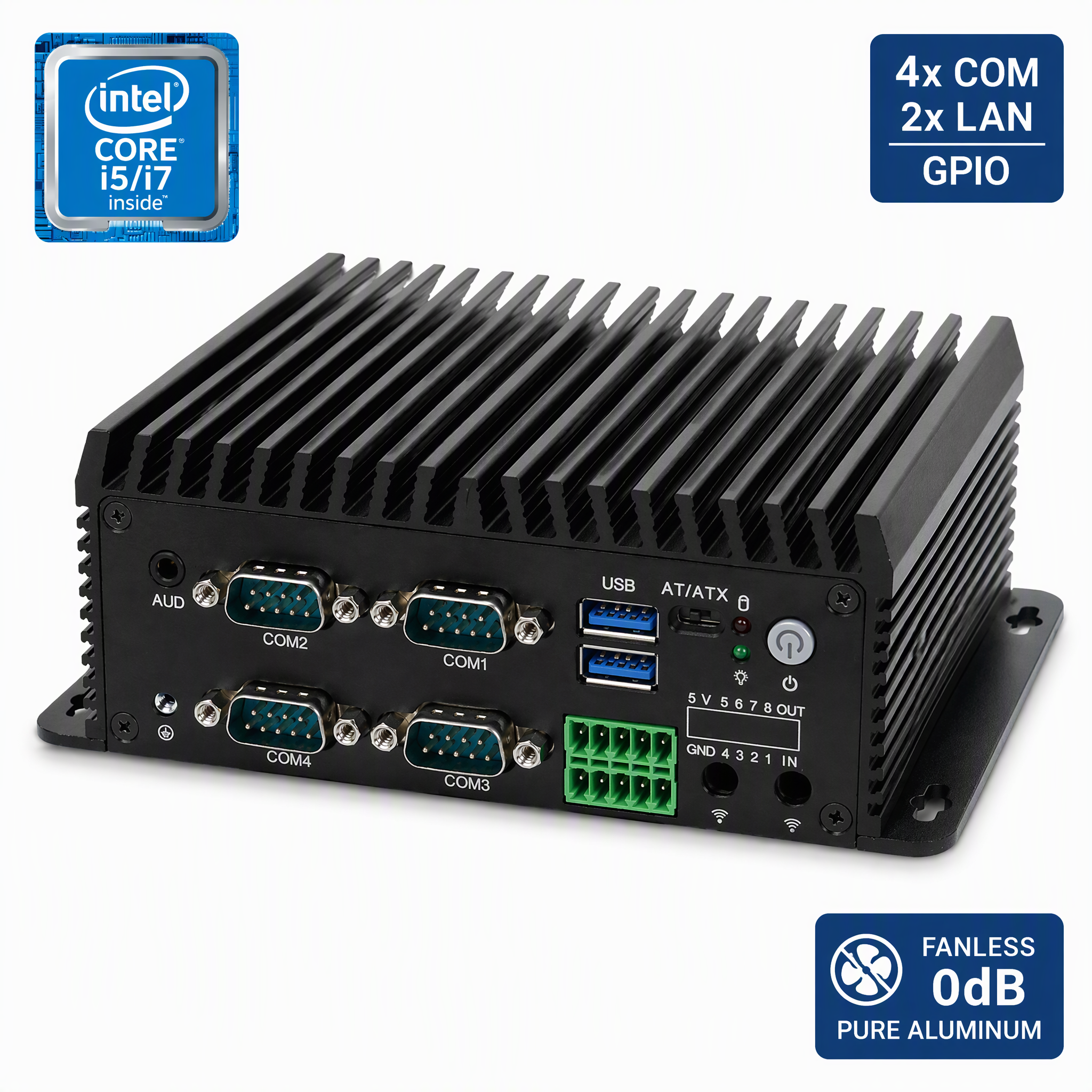
For instance, specialized edge devices like a fanless Embedded Industrial PC powered by Intel Core i3, i5, or i7 processors serve as prime examples of ruggedized architecture built explicitly for stable firmware execution. Featuring a resilient fanless design, dual LAN capabilities, and dedicated COM ports, this caliber of hardware provides the physical foundation required to support advanced partitioning and secure remote management. Organizations looking to standardize their fleet management protocols and ensure seamless update lifecycles should prioritize hardware engineered with these embedded safeguards.
Firmware version control within an industrial context is a complex but undeniably vital operational ecosystem. It requires a harmonious blend of secure bootloaders, meticulous code repositories, strict semantic versioning, and fail-safe hardware rollback mechanisms. By treating low-level code management with the same rigor as physical machine maintenance, organizations can effectively eliminate the costly downtime associated with botched software deployments.
As industrial automation and edge computing networks continue to expand in scale and complexity, the ability to securely and reliably update field devices will remain a major competitive advantage. Factory operators and system integrators must proactively evaluate their current update pipelines. The industry is moving away from reactive manual patching toward automated, highly secure architectures supported by resilient, fanless industrial hardware.
To ensure your manufacturing infrastructure is equipped to handle secure, automated firmware lifecycles, we highly recommend evaluating your current hardware capabilities. Browse the extensive catalog at MeetIPC to find fanless, dual-LAN, and secure-boot capable industrial computing solutions perfectly tailored to your operational requirements.
If the computing system is designed correctly with a dual-bank partitioning architecture, a failed update will trigger a hardware watchdog timer. This automated mechanism detects that the system has hung or failed to boot properly, forcing the device to reboot and automatically roll back to the previous, known-stable firmware version on the secondary partition. This ensures continuous machine operation without requiring emergency manual intervention from an on-site technician.
Firmware is the highly specialized, low-level code that directly interacts with and controls the bare-metal hardware components. Its responsibilities include allocating memory, initializing microprocessors, and controlling electrical power to external ports. Embedded software, conversely, sits above this firmware layer and an operating system, handling higher-level application logic, data processing algorithms, graphical user interfaces, and cloud network communications.
Remote updates are secured using a combination of encrypted network tunnels and asymmetric cryptographic digital signatures. Before an update is applied, the secure bootloader on the device mathematically verifies the digital signature of the incoming firmware payload against a public key stored permanently on the hardware. If the signature matches, the code is authentic and unaltered. If it fails, the installation is blocked, preventing the execution of unauthorized or malicious code.
Semantic Versioning provides a universal, standardized language for both development engineers and automated deployment systems. It instantly communicates the exact nature and risk level of an update. It clarifies whether a new release is merely a minor, low-risk bug fix, introduces a new backward-compatible feature, or involves a massive structural overhaul that might require corresponding physical hardware adjustments.
Engineers typically verify the active firmware version by querying the device through a secure command-line interface, accessing the local diagnostic web server, or checking the centralized fleet management dashboard. The system will return the semantic version number currently loaded in the active memory partition, allowing operators to cross-reference it with the latest official release notes.
In a properly architected industrial system, firmware updates do not erase user configurations or machine calibration data. Configuration files and operational parameters are stored in a separate, non-volatile memory sector independent of the core firmware partitions. When the new firmware boots, it simply reads the existing configuration data from this isolated sector, ensuring the machine resumes its specific operational duties seamlessly.


