
Views: 0 Author: Site Editor Publish Time: 2026-11-10 Origin: Site


Are slow quality checks bottlenecking your production line? Automated machine vision has completely transformed manufacturing. Yet, inspection lines are growing more complex. They now use deep learning, 3D imaging, and high-speed multi-camera setups. Because of this, traditional cloud computing simply cannot keep up.
Cloud systems often fail at real-time defect detection. Sending massive video files across networks causes unacceptable delays. You need localized processing power to eliminate this exact bottleneck. By processing massive amounts of visual data directly on the factory floor, an Industrial Edge PC eliminates latency. It ensures strict data privacy and provides the raw computational muscle needed for real-time AI inferencing. But buying the right hardware is only half the battle.
Properly commissioning this equipment for a vision inspection line is a meticulous engineering process. It dictates the success, accuracy, and reliability of your entire quality control system. In this comprehensive guide, we will walk you through setup steps, hardware choices, software deployment, and practical ways to overcome integration challenges.
Edge Over Cloud: Processing high-bandwidth video data locally ensures ultra-low latency. It enables real-time defect detection without relying on continuous internet connectivity.
Hardware is Foundation: Selecting the correct computing hardware is a prerequisite for successful commissioning. You need specific I/O ports like GigE and USB 3.0, paired with ruggedization features like wide temperature tolerance.
Systematic Commissioning: Reliable deployment requires a phased engineering approach. This includes physical mounting, camera integration, network configuration, AI model deployment, and empirical calibration.
ROI and Efficiency: Systematic commissioning minimizes false reject rates. It optimizes throughput and transforms a standard vision system into a continuous, automated monitoring asset.
An industrial edge computing device is a ruggedized, high-performance system deployed directly at the source of data generation. In this context, that means the factory floor. Traditional centralized servers are hidden away in climate-controlled IT rooms. In contrast, edge computing brings data processing geographically closer to the inspection line. Its primary function in vision systems is to capture, process, and act upon high-resolution image data in milliseconds. By operating locally, it bypasses the bandwidth limitations inherent in cloud networks. This enables the deterministic responses required for high-speed manufacturing environments.
Smart cameras integrate a sensor and a basic processor into a single unit. However, their application is often severely limited by processing constraints. They excel at simple, rule-based tasks like barcode reading or basic presence detection. As inspection criteria become more complex, standalone cameras struggle to scale.
When a production line requires multiple high-resolution lenses or deep learning algorithms to detect subtle cosmetic flaws, a centralized computing hub becomes necessary. A dedicated localized processor provides the computational overhead needed for advanced, multi-camera, AI-driven quality control. Consequently, it has become the standard choice for modern automated inspection.
Recent industry trend analyses reveal a massive surge in localized edge computing deployments. Driven by modern automation initiatives, manufacturers are realizing that the sheer volume of data generated by optical sensors overwhelms even robust cloud architectures. Analysts note a definitive pivot towards decentralized AI at the edge. This shift is not just about speed. It is about data sovereignty and operational resilience.
Facilities can now process complex variables, including organic material inconsistencies or highly reflective metallic surfaces, without relying on external bandwidth. By keeping proprietary manufacturing processes and defect data on the local network, facilities simultaneously solve bandwidth bottlenecks and fortify their data security.
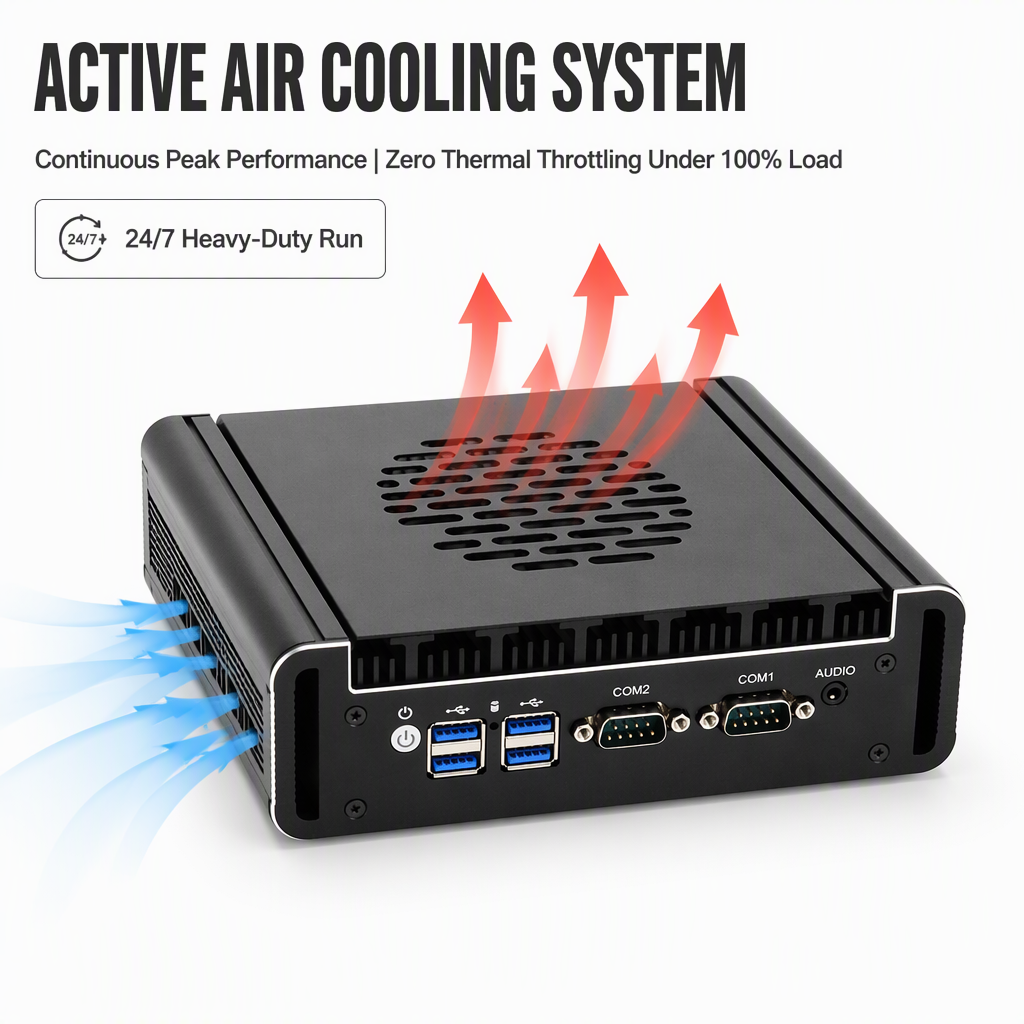
Machine vision algorithms, particularly those utilizing deep neural networks, require significant computational resources. High-performance CPUs handle the system's sequential logic and network traffic management. For pixel-by-pixel image analysis and neural network inferencing, parallel processing is absolutely required. Selecting the right processing architecture ensures that the system can analyze images significantly faster than the mechanical production line moves. Modern units often leverage robust processors, like Intel Core i3 or i7 12th Gen architectures, to handle these intensive workloads without throttling.
The interface between the optical sensor and the computing unit dictates the reliability of the data stream. Machine vision systems rely heavily on rapid data transfer protocols. Gigabit Ethernet is the industry standard for long cable runs and high data transfer rates. Meanwhile, USB 3.0 is frequently utilized for shorter distances requiring high bandwidth. Furthermore, Power over Ethernet greatly simplifies deployment by delivering both data and power over a single Cat6 cable. In practice, this reduces cable clutter inside moving robotic parts and minimizes the risk of wire fatigue.
Space on a factory floor is a premium commodity. Standard desktop towers simply cannot fit inside standard NEMA or IP-rated control enclosures. Integrating a mini industrial computer into existing electrical cabinets allows engineers to add significant processing power without redesigning the physical layout of the inspection station. These compact units are designed to interface seamlessly with standard DIN rails or VESA mounts. This optimizes the footprint of the quality control system while leaving room for necessary PLC wiring and power supplies.
Commercial-grade electronics fail rapidly in industrial environments due to particulate ingress, thermal stress, and mechanical vibration. Industrial-grade hardware utilizes specialized cooling architectures. Depending on the thermal load, this might involve fanless extruded aluminum heatsinks or highly reliable active cooling systems designed for harsh environments. Additionally, they are engineered with wide operating temperature ranges and utilize solid-state drives to withstand the constant shock generated by heavy machinery like stamping presses or high-speed conveyors.
To make the selection process clearer, let us look at a direct comparison of computing architectures commonly considered for vision inspection.
Feature | Consumer/Standard PC | Standalone Smart Camera | Industrial Edge PC |
|---|---|---|---|
Processing Power | Standard CPU, throttles under heat | Basic integrated DSP | Intel Core i3/i7 12th Gen for heavy AI workloads |
Cooling Design | Standard fans, prone to dust failure | Passive, low heat generation | Ruggedized active cooling or fanless heatsinks |
Mounting Options | Desktop tower | Fixed bracket | DIN Rail Mount or VESA for cabinet integration |
I/O & Connectivity | Standard USB, single LAN | Limited, usually single cable | Dual GigE, multiple USB 3.0, isolated COM ports |
Power Input | Standard AC plug | PoE or 24V DC | Wide voltage input, such as 9V to 36V DC |
A single 4K machine vision camera capturing at 60 frames per second generates massive amounts of uncompressed data. When multiplexing three or four cameras into a single system, data bottlenecks can easily occur at the network interface. To prevent packet loss and frame dropping, engineers must implement Jumbo Frames on network adapters. Utilizing dedicated host controllers for each camera stream ensures video traffic does not interfere with standard plant communications.
Factory floors introduce variables that disrupt both optical systems and sensitive electronics. Electromagnetic interference from heavy motors can corrupt data signals over unshielded cables. Moisture, oil mist, and ambient light fluctuations can drastically alter image quality. Mitigating these hazards requires shielded cabling, robust M12 threaded connectors, and localized strobe lighting that overpowers the ambient factory illumination.
In a continuous manufacturing line, the time delta between image capture and the actuation of a mechanical reject gate is strictly finite. If the AI inference takes 50 milliseconds but the product passes the reject gate in 40 milliseconds, the defective item slips through. Commissioning requires rigorous timing analysis. Real-time operating systems or specialized hardware triggers are often necessary to guarantee deterministic network behavior and execute logic within the strict mechanical timing window.
Continuous AI model training requires storing thousands of images of defective products. Logging high-resolution images continuously will rapidly exhaust local storage capacities. Engineers must configure logical storage rules, saving only defective frames or utilizing circular logging, to prevent the system from crashing due to a full disk. Robust storage solutions like high-endurance NVMe SSDs configured in RAID arrays are heavily recommended.
The commissioning process begins with secure physical integration. The computing unit should be mounted using standard industrial methods to ensure it is firmly attached and resistant to machine vibration. Proper orientation is absolutely necessary for thermal management to ensure optimal convective airflow. Grounding the chassis directly to the control panel is a mandatory safety and performance step to mitigate static discharge and electromagnetic interference.
Once the computing hardware is secured, the optical components are integrated. Cameras must be rigidly mounted using vibration-dampening brackets. Crucially, lighting calibration must be established. In practice, this means synchronizing strobe controllers with the camera trigger to provide intense, microsecond bursts of illumination. This effectively freezes the motion of high-speed products, ensuring the AI model receives a crisp and blur-free image.
Network stability is the backbone of automated inspection. Cameras must be assigned static IP addresses on an isolated subnet. This must be completely separate from the general factory network to prevent broadcast storms from disrupting video streams. Next, digital I/O configuration is established to allow the industrial PC to communicate with Programmable Logic Controllers. This involves wiring opto-isolated inputs for the camera trigger and outputs for the physical reject mechanism.
The final step in this hardware phase is software calibration. The field of view must be digitally calibrated to real-world measurements, translating pixel dimensions into real-world millimeters, to ensure accurate defect sizing. Image masking techniques are configured to instruct the software to ignore irrelevant background noise like moving conveyor belts. This focuses processing power purely on the designated inspection zone of the product.
The choice of software ultimately dictates the system's capabilities. Traditional rule-based machine vision relies on geometric pattern matching and edge detection. This is highly effective for precise measurements and rigid part inspection. Conversely, modern deep-learning AI platforms are better suited for complex and subjective inspections. Identifying unpredictable scratches, variations in organic materials, or complex assembly verification requires neural networks. Often, a hybrid approach combining both methods yields the most reliable results on the factory floor.
Training a complex AI model typically occurs on high-performance cloud servers or dedicated offline workstations. Moving that model to the factory floor requires specific edge inferencing optimization. Pre-trained neural networks are deployed onto the localized hardware utilizing edge-optimized frameworks. These frameworks quantize the models, reducing their computational footprint without significantly degrading accuracy. This is how engineers achieve the required real-time inference speeds.
Detection is only valuable if it results in a physical action. The vision software must be programmed to execute automated logic based on the inference results. This involves configuring communication protocols like Modbus TCP or PROFINET to interface seamlessly with the main line controller. When a defect is detected, the software sends a precise timing signal to actuate sorting gates, trigger visual alarms, or halt the conveyor system entirely.
Before the system is handed over to active production, it must undergo rigorous Site Acceptance Testing. This involves running the commissioned system under normal operating speeds using a predefined set of known good and known bad samples. Engineers calculate the accuracy rates by plotting a confusion matrix. Analyzing the True Positives against False Positives and False Negatives ensures the mechanical rejection systems operate reliably under real-world conditions.
Commissioning rarely proceeds without friction. Dropped camera frames are a frequent issue. This is typically resolved by adjusting the network adapter's interrupt moderation or increasing packet size limits. Network timeout errors often point to inadequate PoE power budgets or faulty cabling. If the system generates excessive false positives, the root cause is usually environmental. Shifting ambient light or mechanical vibration moving the camera out of focus requires physical adjustments rather than endless software tweaking.
A properly commissioned system should function as an autonomous asset. Modern rugged computing hardware supports Self-Monitoring, Analysis, and Reporting Technology. Engineers can configure the system to monitor its own health metrics. Tracking CPU thermal throttling, memory usage, and SSD write-cycle degradation is vital. By setting up automated alerts for these hardware metrics, maintenance teams can transition from reactive repairs to predictive maintenance. Replacing components during scheduled downtime prevents catastrophic failures from halting the line.
The primary financial metric for any vision system is its impact on the yield rate. Legacy systems with limited processing power often err on the side of caution. This leads to high False Reject Rates, discarding perfectly good products. The superior processing power of an edge computing architecture allows for the deployment of highly complex, nuanced AI algorithms. These algorithms can accurately differentiate between a critical structural defect and a benign surface watermark. Ultimately, this drastically reduces material waste and improves overall accuracy.
Calculating the Total Cost of Ownership extends far beyond the initial hardware purchase. An optimized edge vision system eliminates the need for manual inspection sampling. It allows the production line to operate at its maximum mechanical speed. When factoring in the reduction of manual labor costs, the minimization of defective products reaching consumers, and the extended operational lifespan of ruggedized hardware, the empirical ROI of a properly commissioned system is typically realized within the first fiscal year.
Commissioning computing hardware for a vision inspection line is a multi-layered engineering task. It bridges the gap between rugged hardware, high-speed networking, and advanced artificial intelligence. The process comes with its unique set of challenges, ranging from environmental hazards to strict latency constraints. However, following a systematic commissioning framework ensures operational stability.
By investing in the correct industrial infrastructure and meticulously configuring the optical, network, and software layers, manufacturers can achieve unprecedented levels of quality control. Ready to upgrade your inspection line? Evaluate your processing needs and environmental constraints, and choose an industrial computing solution that guarantees real-time reliability. Explore high-performance options at MeetIPC to find the exact hardware parameters required for your next automation project.
An industrial edge PC is built with rugged components, specialized cooling, and wide temperature tolerances to survive harsh factory environments. Standard commercial PCs use standard active cooling fans that draw in dust. They will quickly fail under the constant vibration, electromagnetic interference, and temperature extremes found on manufacturing floors.
A compact footprint allows the device to be easily integrated into existing, space-constrained electrical cabinets on the inspection line. Despite their small size, they do not sacrifice processing power. They provide the necessary CPU capabilities to handle high-resolution image processing efficiently without requiring expensive facility redesigns.
While CPUs handle sequential logic and machine communication, GPUs are designed for parallel processing. In machine vision, analyzing millions of pixels simultaneously or running deep learning inference models requires massive parallel computation. A dedicated GPU or AI accelerator drastically reduces image processing time, ensuring the system keeps up with high-speed conveyor belts.
Industrial computers manage heat through specialized thermal designs. Fanless models use heavily finned extruded aluminum chassis that act as massive heatsinks, dissipating heat passively into the surrounding air. For higher-performance units like those running Intel Core i7 processors, specialized rugged active cooling systems are utilized to maintain optimal temperatures without drawing conductive factory dust directly onto the motherboard.
Depending on the complexity of the AI models and the number of cameras, commissioning can take anywhere from a few days for a basic setup to several weeks for highly complex, multi-line deployments. Complex setups often require deep learning model training, custom lighting fabrication, and extensive mechanical synchronization.
Yes. High-end industrial computers equipped with multiple PoE or USB 3.0 ports and powerful processors can process streams from multiple high-resolution cameras simultaneously. This reduces the need for multiple discrete computing devices and simplifies the overall network architecture.
The most common operating systems for industrial environments are Windows 10 or 11 IoT Enterprise, which offer long-term stability and disable forced updates. Various Linux distributions, like Ubuntu, are also heavily preferred for custom AI and edge inferencing deployments due to their low system overhead and high customizability.


