The UNO is a fanless embedded industrial PC in a 190 × 150 × 71 mm aluminum chassis, running Intel Core i3/i5/i7 from 6th to 13th Gen with DDR4 up to 64 GB. It brings 4 COM, 2 Intel GbE, 8 USB, VGA + HDMI + DP triple display, an 8-bit GPIO block and a remote power switch terminal into a machine-mounted box that needs no fan, no filter and no cabinet airflow.


The UNO is a compact embedded industrial computer: a machined aluminum chassis with cooling fins on top, no fan, no intake filter and no moving part. At 190 × 150 × 71 mm it fits on a DIN rail shelf, inside a control cabinet or on the back of a machine, and it runs from a 12–19 V DC supply rather than mains.
What separates it from a consumer mini PC is what comes out of the front and rear panels: four serial ports, two Intel Gigabit LAN ports, eight USB ports, triple display output and an 8-bit GPIO block with a remote power switch terminal. That combination covers most machine-building and SCADA projects without adding a single adapter.

The chassis is the heatsink. Heat moves from the CPU to the aluminum body through a direct contact plate, and the deep fins on top dissipate it by convection. There is no fan bearing, no dust filter and no airflow path, which is why the unit is rated for 24/7 operation in cabinets where a fan-cooled PC would clog within a year.
The trade-off is honest: passive cooling limits the sustained CPU power budget. A 12th or 13th Gen i7 will run at its base clock under long full-load rendering or AI inference, and will only boost in bursts. For continuous heavy compute, tell us the workload and we will recommend a chassis with active cooling instead of letting you discover throttling in the field.

Front panel: four DB9 serial ports (COM1–COM4, RS-232 or RS-485 selectable), two USB 3.0 ports, an 8-pin GPIO terminal, the AT/ATX switch, a power button with LED and a 3.5 mm audio jack. Rear panel: two Intel Gigabit LAN ports, two USB 3.0 and four USB 2.0, VGA, HDMI, DisplayPort, a two-pin remote switch terminal, DC input and two antenna cut-outs.
The serial ports are the reason most customers choose this box. Scales, flow meters, barcode readers, VFDs and older PLCs still speak RS-232 or RS-485, and four ports on the front mean no USB-to-serial adapters hanging off the machine — the most common source of intermittent faults on a shop floor.

The 8-pin GPIO block gives four dry-contact inputs and four 5 V open-collector outputs. In practice that means a door sensor, a limit switch or an emergency-stop contact can start a sequence or raise an alarm, and the outputs can drive a stack light, a buzzer, a relay or a solenoid valve directly.
The remote switch terminal is a two-pin connector for an external momentary push button, so a sealed cabinet can be powered on and off without opening the door. Together with the AT/ATX jumper — which makes the PC start automatically when power returns after an outage — this is what makes the unit usable in an unmanned cell.

All three outputs work at the same time, in mirrored or extended mode, so one box can drive a SCADA overview, a machine-data screen and a camera wall without a graphics card. The DisplayPort output reaches 4K on the integrated GPU; VGA stays available for the older panel that is still bolted to the machine.
Extended mode across three screens is configured in the operating system, not in the BIOS, so the layout survives a reinstall. If your application needs to pin a window to a specific screen, tell us at quotation stage and we will validate it on the bench.

The platform spans eight CPU generations on the same chassis, which matters for projects with a two- or three-year deployment: you can specify a 6th Gen i5 today at a lower cost and move to a 12th or 13th Gen i5 for the next phase without changing the mechanical design, the mounting or the I/O.
Memory is two SO-DIMM DDR4 slots up to 64 GB, and storage is split between an mSATA system drive and a 2.5-inch SATA bay for data up to 2 TB. Keeping the OS on mSATA and logs or images on the SATA disk means a storage upgrade does not require reinstalling the system.

Supported systems are Windows 10 and 11 64-bit, Windows IoT, Ubuntu and Debian. Drivers for the Intel graphics, the dual Gigabit LAN and the serial ports are supplied with the unit, and we can pre-install your image and run a burn-in test before dispatch.
Windows 7 and 8 are not part of the supported list. If your application is locked to an older OS, say so at enquiry stage — it constrains both the CPU generation and the chipset, and it is better settled before the BOM is fixed than after.
Standard input is DC 12–19 V through a locking barrel jack; a 9–36 V wide-voltage board is available as a custom option for vehicles, battery plants and 24 V control systems where the rail is not stable. Ignition power control is available on the same custom path for fleet and vehicle installations.
Mounting is by the built-in ears for wall or backplate fixing, or on a flat shelf; a DIN rail clip is an option. Because the fins run across the top, leave 30 mm of clearance above the unit and do not stack paper or cable ducts on it — that is the single most common installation mistake with a passive chassis.

Beyond the standard panel, the platform can be built with up to six COM ports (RS-232/422/485), up to six LAN ports using Intel i210 or i225 controllers with 2.5 GbE available, one PCIe x4/x8/x16 slot for a frame grabber, a motion card or a GPU, a 4G/5G module with SIM slot on mini-PCIe or M.2, and optional PoE, isolated COM or extra DIO.
This is where a project stops being a catalogue order. Send the port list, the card models and the power rail, and we will come back with a configured drawing rather than a generic datasheet — the lead time on a custom panel is quoted against that drawing.
· Factory automation — cell controllers, data acquisition and line-side HMI hosts
· CNC and robotics — machine-mounted control with serial links to drives and PLCs
· Machine vision — dual GbE for camera networks, PCIe slot for a frame grabber
· Smart logistics — AGV and AMR onboard computing, wide-voltage input
· SCADA and monitoring — three independent displays in one control room box
· Building and energy systems — DIN rail or cabinet mounting, 24/7 operation
Beyond I/O, the platform is customized at six points: hardware configuration, I/O port layout, BIOS and boot logo, system and software pre-installation, testing and quality assurance, and after-sales technical support. Tell us the port list and the enclosure marking and we will quote against a drawing rather than a catalogue number.
The unit can be supplied with CE, FCC and RoHS documentation for the configuration you order; the declaration of conformity is issued against the exact BOM, because the radio module, the LAN controller and the power board change the test scope. Our factory runs an ISO 9001 quality system with 12 inspection points and a repair rate below 0.5%, and Meetneng holds more than 30 patents in industrial computing.
Every unit is assembled, powered, burned in and function-tested — including all serial ports, both LAN ports and the GPIO block — before packing. Warranty is one year on the complete unit plus three years on hardware, with a seven-day return window for units that do not match the agreed specification. Stocked configurations ship within 72 hours; custom panels and OEM builds are quoted with a lead time against your drawing.
Item | Specification |
Model | UNO |
Type | Fanless embedded industrial PC (box PC) |
Processor | Intel Core i7 / i5 / i3, Celeron — 6th to 13th Gen optional |
Memory | 2 × SO-DIMM DDR4 1866/2133/2400/2666/3200 MHz, up to 64 GB |
Storage | 1 × mSATA + 1 × 2.5-inch SATA HDD/SSD bay, up to 2 TB |
LAN | 2 × Intel Gigabit Ethernet (up to 6 ports on custom builds) |
Serial | 4 × COM, RS-232 / RS-485 selectable (up to 6 on custom builds) |
USB | 4 × USB 3.0 + 4 × USB 2.0 |
Display | 1 × VGA + 1 × HDMI + 1 × DisplayPort, synchronous or asynchronous |
Audio | 1 × MIC / line-out |
GPIO | 8-bit GPIO, 5 V — 4 inputs (dry contact) / 4 outputs (open collector) |
Remote control | 1 × remote power switch terminal; AT / ATX auto power-on |
Power input | DC 12–19 V standard; DC 9–36 V wide voltage optional |
Operating system | Windows 10 / 11 64-bit, Windows IoT, Ubuntu, Debian |
Chassis | Aluminum alloy, fanless passive cooling |
Mounting | Desktop / wall mount (built-in ears) / DIN rail (optional) |
Dimensions | 190 × 150 × 71 mm (W × D × H) |
Operating temperature | -20 °C to 60 °C |
Storage temperature | -40 °C to 85 °C |
Humidity | 5% to 95% RH, non-condensing |
Custom I/O | Up to 6 COM (RS-232/422/485), up to 6 LAN (i210/i225, 2.5G optional), 1 × PCIe x4/x8/x16, 4G/5G with SIM (mini-PCIe / M.2), ignition control, PoE, isolated COM, DIO |

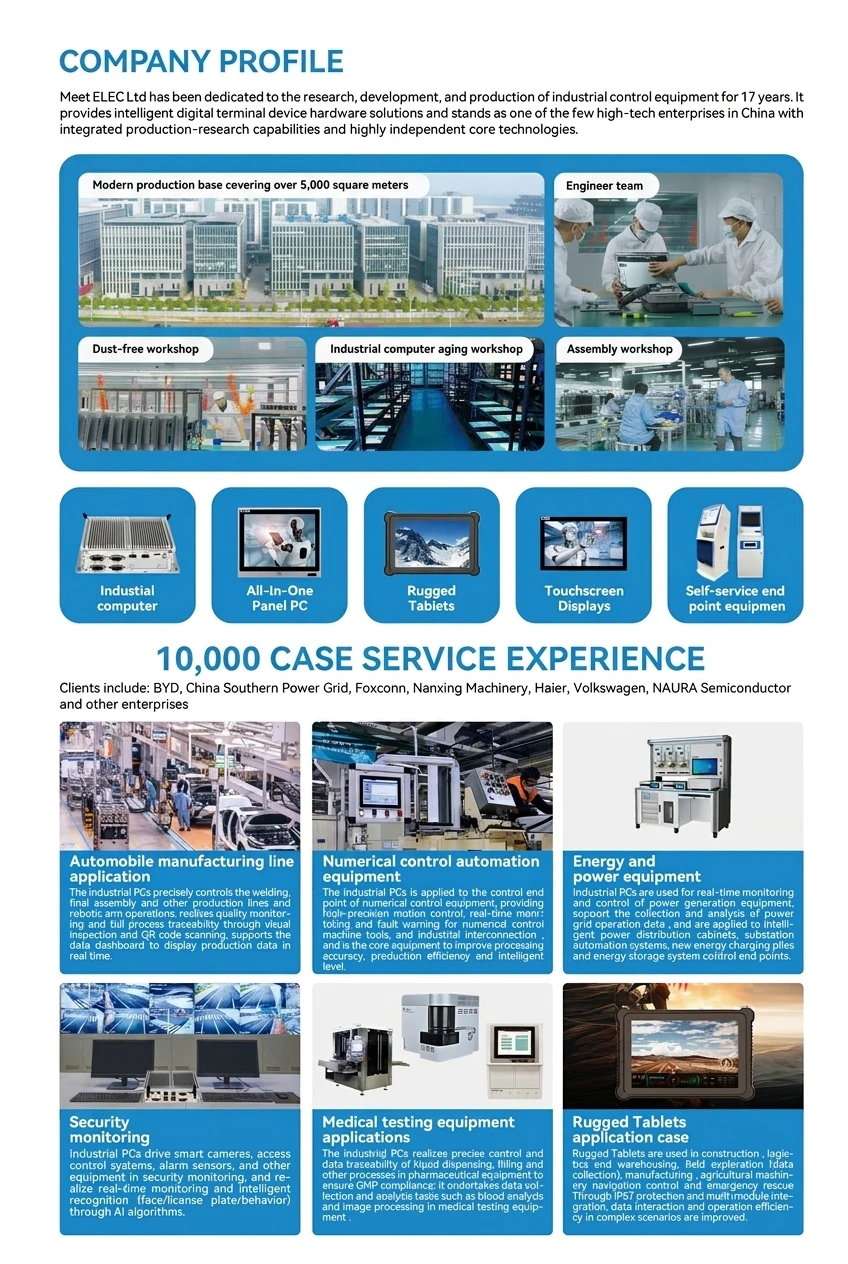
Meetneng (Foshan Lineng Electronic Equipment Co., Ltd.) is an industrial computing manufacturer based in Shunde, Foshan, Guangdong, China. Founded in 2008, the company designs, builds and supports industrial panel PCs, fanless industrial PCs, embedded computers, rackmount servers, industrial displays and rugged tablets for automation projects worldwide.
Our 5,000 m² production base runs an ISO 9001 quality system with a 12-step inspection process covering incoming components, assembly, burn-in, function testing and final packing. Units are built from globally sourced components, and our field repair rate is kept below 0.5%.
OEM and ODM are core to how we work rather than an add-on service. Our engineering team adjusts display size, processor platform, memory and storage, interface layout, enclosure structure, operating system image and branding to match a specific machine or project — from a single evaluation unit to series production, with drawings for approval before tooling.
Meetneng products are used in factory automation, smart manufacturing, machine vision, transportation, energy, medical equipment and industrial IoT. Every project is supported by pre-sales configuration advice, testing before shipment, and after-sales remote diagnostics with spare-parts supply.
Meetneng is backed by the Vinwo Electronics Group and employs a 20-plus member R&D team holding more than 30 patents in industrial computer and display design. The 5,000 m² factory follows ISO 9001 with 12 inspection nodes and produces a catalogue of over 1,000 product types, supported by more than 30 certificates covering safety, EMC, environmental compliance and design patents.
Products are exported to more than 100 countries and regions and are in service with over 15,000 customers, including Haier, Gree, BYD, Hikvision, Foxconn and CRRC. That customer base is the reason our configurations are standardized rather than improvised: the same chassis, mounting pattern and BIOS behaviour are already deployed in production environments, so a new project starts from a proven baseline instead of a prototype.
If you are standardizing a plant, retrofitting an existing machine or sourcing a private-label industrial PC, send us the application and peripheral list — we will propose a configuration and a sample schedule.