
Views: 0 Author: Site Editor Publish Time: 2026-11-22 Origin: Site


Language barriers can easily kill a lucrative international deal in our hyper-connected global economy. Free smartphone apps might work for casual tourists. Business professionals need something entirely different. They demand reliability, speed, and absolute discretion. A single miscommunication during a B2B negotiation or a supply chain audit can destroy corporate relationships. Are automated tools truly capable of handling enterprise communication?
Enter dedicated AI translation devices. These specialized units far surpass the capabilities of mobile apps. They are rapidly becoming essential investments for multinational companies. This guide explores exactly how precise these systems are today. We will separate outdated myths from modern reality and outline the critical hardware features organizations must evaluate when upgrading their corporate communication toolkits.
High Accuracy Rates: Modern enterprise-grade hardware leverages Neural Machine Translation to achieve up to 95 to 98 percent accuracy in major global business languages.
Context and Nuance: Human interpreters remain superior for highly sensitive cultural diplomacy. Artificial intelligence excels at real-time factual business data exchange.
Essential Business Features: The most effective tools for corporate use include Active Noise Cancellation, robust offline processing capabilities, and dual-screen interfaces for frictionless conversations.
Security and Privacy: Dedicated corporate hardware provides strict data encryption for confidential meetings. This significantly outperforms free consumer smartphone applications that often monetize user data.
Cost-Effective ROI: Investing in professional translation hardware drastically reduces the recurring operational costs associated with hiring human interpreters for routine business travel and standard vendor negotiations.
How did we get here? Early translation software relied heavily on Statistical Machine Translation. This older technology processed text word-for-word. These legacy systems frequently failed to grasp grammar, idioms, or contextual meaning. The result was robotic and disjointed. It was completely unsuitable for professional environments where clarity is paramount.
The real breakthrough came with Neural Machine Translation. Deep learning algorithms now analyze entire sentences simultaneously. They understand the context of a word within a broader structural framework. This allows modern systems to generate highly natural translations that mimic native speech patterns.
Many executives try using consumer apps first. The friction is immediate. Smartphones invite distractions. A sudden push notification can derail a sensitive negotiation. Continuous microphone use drains the battery rapidly. Standard phone microphones fail to capture voices clearly in a large conference room.
Forward-thinking organizations are switching to purpose-built AI voice translators. These specialized units feature optimized microphone arrays and distraction-free interfaces. They ensure professional and uninterrupted communication.
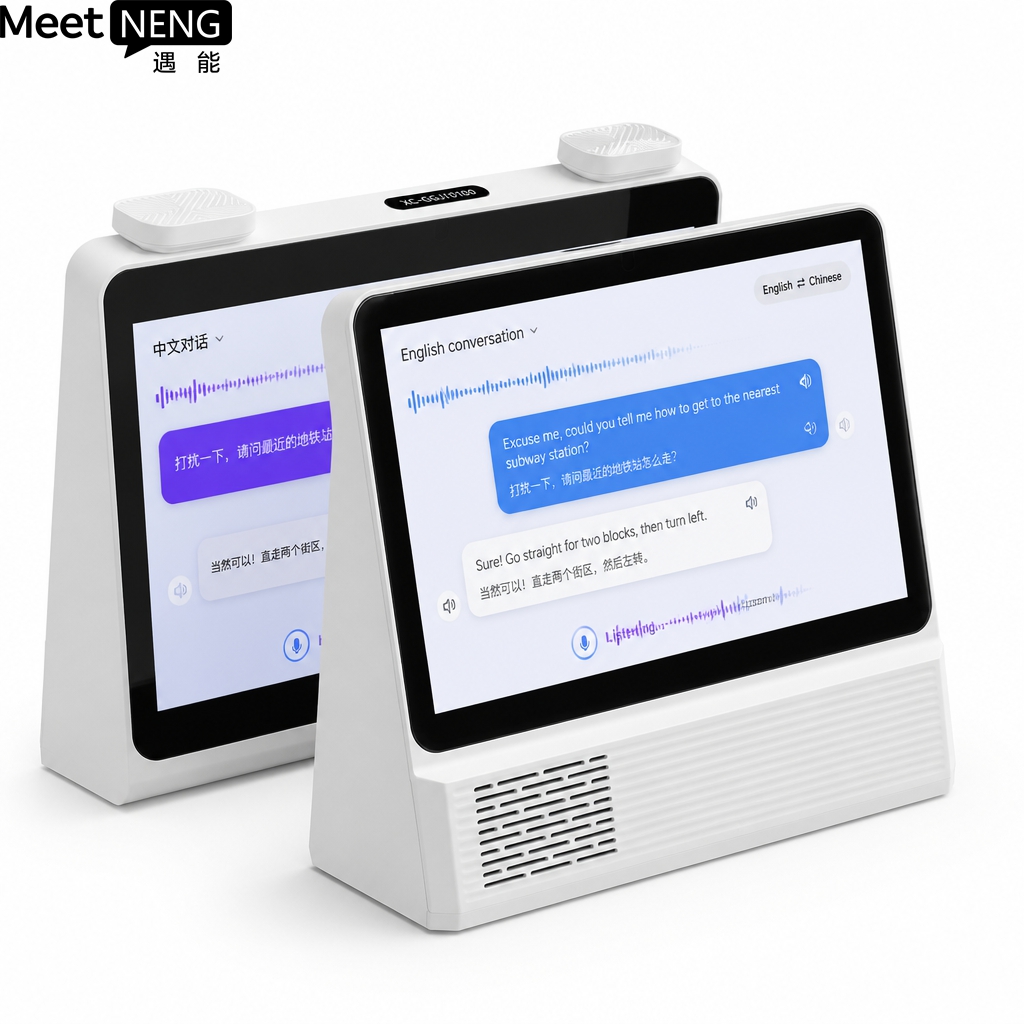
A lingering myth suggests automated translation is rigid and prone to embarrassing contextual errors. That skepticism made sense ten years ago. Today, it is outdated. When speakers articulate clearly in major commercial languages like English, Mandarin, Spanish, or German, current devices routinely hit accuracy benchmarks of 95 to 98 percent.
Let us look at current market dynamics. Enterprise communication trends show a massive shift toward edge computing integrated with neural networks. Multinational corporations no longer just want basic linguistic conversion. They demand secure and zero-latency hardware. They need devices that operate completely independently of vulnerable public Wi-Fi networks. This ensures proprietary data stays entirely on-device during overseas deployments.
The precision of a translation tool heavily depends on its data processing architecture. Cloud-based translation represents the gold standard for accuracy. The device routes audio to massive remote data centers when connected to secure Wi-Fi. These servers run resource-intensive language models. This allows for incredibly accurate translations that continuously learn new global terminology.
What happens in a remote manufacturing plant? On-device translation relies on downloaded language packs processed directly by the internal neural chip. Recent advancements in mobile processing power have made offline translation highly reliable. This provides a vital safety net for professionals operating in secure corporate facilities.
A critical metric for business utility is handling specialized vocabulary. Modern neural engines are increasingly trained on vast datasets encompassing technology, finance, healthcare, and logistics. The software correctly interprets industry-specific jargon that would easily confuse a basic consumer app.
Objective evaluation requires acknowledging current limitations. Artificial intelligence is highly accurate for standard B2B dialogue and technical specifications. It may struggle with deep cultural idioms. A human-in-the-loop approach remains the most prudent strategy for extremely sensitive legal contracts or highly nuanced diplomatic negotiations.
Feature | Smartphone Apps | Enterprise Translation Devices |
|---|---|---|
Audio Capture | Basic omnidirectional mic | 4-Mic array with Active Noise Cancellation |
Data Security | High risk of data monetization | End-to-end encryption and strict local processing |
User Interface | Single screen shared awkwardly | 10.1-inch dual-screen flat-lay design |
Document Scanning | Standard phone camera | Dual 5MP OCR optimized for text |
Accuracy is not solely a product of sophisticated software algorithms. The physical hardware plays an equally massive role in real-world business environments. The most advanced software will inevitably produce transcription errors if the unit cannot clearly hear the speaker.
Imagine a critical vendor negotiation taking place on a chaotic trade show floor. Picture a quality-control walkthrough amidst the deafening hum of a manufacturing plant. Background noise is the primary enemy of linguistic accuracy in these high-stakes scenarios.
High-end hardware combats this using multi-microphone arrays. A 4-Mic setup paired with Active Noise Cancellation isolates the primary speaker's voice. It simultaneously suppresses ambient chatter and machinery noise. The processor receives a clean audio stream. This drastically reduces errors and ensures precise output regardless of environmental chaos.
Timing is just as important as accuracy in business communication. A delay of more than a second creates awkward pauses. It disrupts the natural rhythm of a conversation. Top-tier enterprise devices utilize dedicated neural processing units to achieve near-simultaneous translation. Translations are delivered in milliseconds to allow for a fluid exchange of ideas.
Understanding where these devices provide the highest return on investment helps organizations deploy them effectively.
Trust is built through eye contact and natural interaction. Two-way translation hardware allows both parties to speak in their native tongues during formal negotiations. Executives can read real-time subtitles or listen to instant audio playback. They can focus entirely on their counterpart's body language and tone.
Navigating daily logistics abroad can be stressful. Dedicated translation units serve as pocket-sized interpreters. They help executives give precise directions to foreign taxi drivers or inquire about flight changes. This independence eliminates the logistical hurdle of booking a human interpreter for every minor interaction.
Multinational customer service centers and luxury retail boutiques utilize these devices to elevate client satisfaction. Sales teams can instantly assist international clients with complex inquiries. They can process returns or explain product specifications accurately. This frictionless communication directly translates to increased sales conversions.
Selecting the right hardware requires evaluating specifications that directly impact business utility. Consumer-grade gadgets lack the robust features necessary for enterprise deployment.
The dual-screen interface is one of the most significant advancements in translation hardware. Traditional single-screen devices force users to awkwardly slide the hardware back and forth across a boardroom table. This breaks eye contact and slows down the conversation.
Consider the workflow upgrade provided by a 10.1" Dual-Screen AI Translator. Both parties sit across from one another and read real-time subtitles simultaneously. The flat-lay design transforms the device into an unobtrusive tool. It enables a natural conversation where both participants feel equally engaged.
Corporate espionage and data leaks are valid concerns. Free translation apps often monetize user data. They potentially expose sensitive meeting transcripts to third-party servers. Enterprise-grade devices are engineered with strict data security standards. They feature end-to-end encryption for cloud processing and provide robust offline modes. Confidential corporate information never leaves the physical device.
Business communication extends far beyond spoken dialogue. Executives constantly encounter foreign-language documents. These range from legally binding NDA agreements to presentation slides. Devices equipped with Dual 5MP OCR cameras can instantly scan and translate printed text. Professionals can independently verify the contents of paper documents in real-time before signing.
The decision between hiring human interpreters and deploying automated devices requires an objective comparison of utility and cost.
Human interpreters charge by the hour. Their fees often include travel and accommodation expenses. These costs accumulate rapidly for a multinational company. Purchasing high-end translation hardware represents a one-time capital expenditure. The return on investment is realized almost immediately.
The most efficient organizations adopt a collaborative approach. Deploy AI devices for daily internal communications, factory floor inspections, and routine B2B meetings. The technology excels at straightforward data exchange. Strategically reserve human interpreters for high-stakes legal arbitrations where interpreting subtle cultural subtext is critical.
Hardware developers are engineering solutions specifically tailored for the boardroom. MeetIPC addresses the exact pain points multinational businesses face. They prioritize pinpoint accuracy, hardware reliability, and a seamless user experience.
The flagship 10.1" Dual-Screen AI Translator represents a paradigm shift. It integrates a massive dual display for true face-to-face subtitles. This completely eliminates the friction of sharing a single screen. The device is engineered with a 4-Mic ANC array to ensure flawless audio capture even in chaotic environments. Coupled with Dual 5MP OCR for instant document translation, it serves as a comprehensive communication hub for any global enterprise.
Modern automated interpreters are indispensable tools for contemporary business needs. They leverage cutting-edge neural networks and noise-canceling hardware to handle standard professional conversations with near-perfect precision. This makes daily global operations remarkably cost-effective.
They do not completely replace human experts for highly sensitive legal matters. However, they provide an overwhelmingly superior financial ROI for routine travel and vendor negotiations. Ready to break down language barriers? Upgrade your corporate communication toolkit today. Explore the full range of professional AI translation devices at MeetIPC and find the perfect hardware solution for your global enterprise.
Yes. Cloud-based translation offers the highest accuracy. Premium hardware features powerful on-device processors. These internal neural engines provide highly accurate offline translation for major global languages. This makes them exceptionally reliable for international travel where Wi-Fi is unpredictable.
Dedicated business translation hardware is much more secure than free smartphone apps. Enterprise-grade devices are designed with corporate privacy in mind. They do not sell your data to third-party advertisers. They often feature secure local processing to protect trade secrets from leaving the device.
High-quality translation devices are specifically equipped with Active Noise Cancellation and multi-microphone arrays. This advanced acoustic hardware allows the device to isolate the primary speaker's voice from heavy background chatter. The translation remains highly accurate even in chaotic environments.
Dual-screen devices allow two people to sit across from one another and read real-time subtitles simultaneously. This eliminates the awkwardness of passing a single device back and forth. It allows for natural eye contact and significantly smoother negotiations.
Top-tier hardware typically achieves an accuracy rate of 95 to 98 percent when speaking clearly in standard business languages such as English, Spanish, Mandarin, or French. This high level of precision makes them highly reliable for professional use.
Older statistical models translated text word-for-word, resulting in robotic and disjointed sentences. Neural machine translation utilizes deep learning algorithms to analyze entire sentences at once. It understands context and grammar, producing fluent translations that sound like a native speaker.
Yes. Enterprise-grade translation engines are trained on vast, sector-specific datasets. Whether you are discussing semiconductor manufacturing specifications, medical device regulations, or supply chain logistics, modern devices can accurately interpret complex technical vocabulary that consumer apps fail to understand.


