
Views: 0 Author: Site Editor Publish Time: 2026-08-27 Origin: Site


System integrators face a massive challenge deploying computing hardware in space-constrained, hostile environments. Localized data processing at the edge requires desktop-class processing power. However, you must balance this performance against the physical realities of thermal management, continuous vibration, and limited enclosure space. Standard commercial hardware fails rapidly under these extreme conditions. This leads to catastrophic system downtime and operational blind spots on the factory floor. This evaluation guide provides a rigorous technical framework for selecting a Mini Industrial PC designed to survive where conventional IT equipment cannot. We analyze architectural trade-offs, varying form factors, specific input/output requirements, and long-term lifecycle management. You will learn how to accurately match physical dimensional constraints with necessary processing capabilities. This approach guarantees your hardware maintains peak performance and uninterrupted uptime across the harshest industrial realities.
Thermal and Spatial Trade-offs: Selecting a compact embedded computer requires balancing processing power (TDP) with available passive cooling surface area to prevent thermal throttling.
I/O Density is Critical: The viability of an industrial edge mini PC often hinges on its ability to support both legacy industrial protocols (RS-232/422/485) and high-bandwidth interfaces (Dual Gigabit LAN, USB 3.2) within a minimal footprint.
Mounting and Form Factor Dictate Design: Deployment environments (DIN-rail cabinets, VESA mounts, embedded chassis) must dictate the physical architecture, whether deploying a headless box PC or an integrated panel PC.
Lifecycle Trumps Initial Cost: Industrial deployments require hardware with guaranteed 5-to-10-year availability roadmaps to avoid continuous recertification of embedded systems.
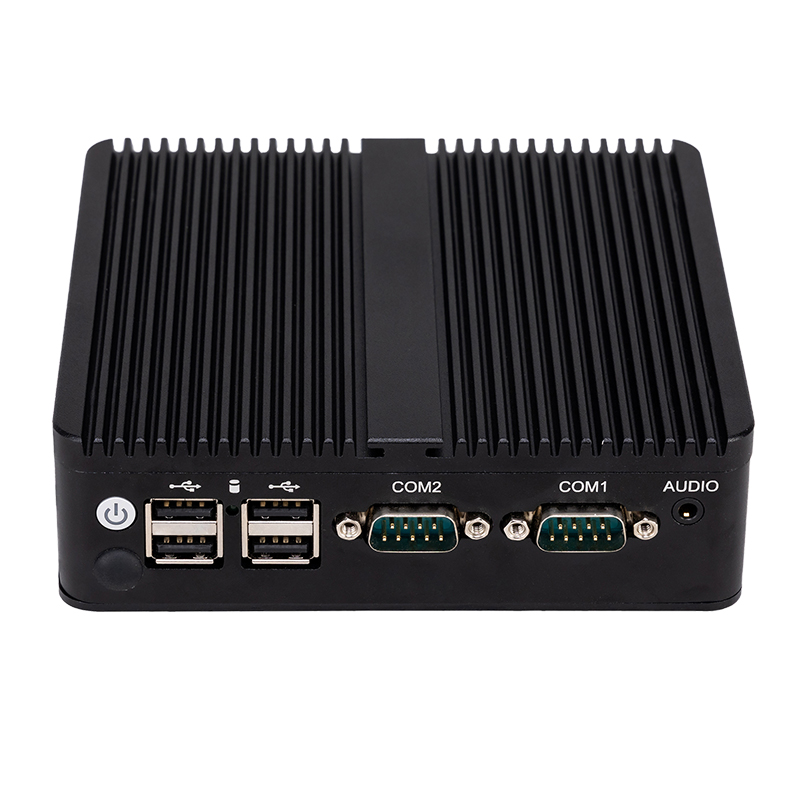
Establishing accurate baseline dimensional constraints is the first step in hardware selection. Engineers must map the available physical volume against the required CPU performance and its associated Thermal Design Power (TDP). High-performance processors generate significant heat. In a compact embedded computer, the surface area of the external chassis acts as the sole heat sink. If the physical footprint is too small to dissipate the TDP of the chosen processor, the system will inevitably experience thermal throttling. This reduces processing speeds and compromises real-time automation tasks. For example, a 15W Intel Celeron processor can operate safely in a chassis the size of a paperback book. A 65W Intel Core i7 requires a significantly larger extruded aluminum enclosure with deep cooling fins to shed the excess thermal load.
Defining the specific operating conditions the hardware must survive goes far beyond standard office parameters. Industrial hardware must often operate flawlessly in wide temperature ranges. A system deployed in an unconditioned outdoor NEMA enclosure in Texas will see ambient temperatures exceed 50°C, while a unit in a cold storage warehouse might operate at -20°C. Standard RAM and SSDs will fail under these extremes. You must specify wide-temperature components rated for -40°C to 85°C. Humidity levels can fluctuate wildly, leading to condensation risks on the motherboard. Particulate exposure requires strict adherence to Ingress Protection (IP) ratings. A system deployed in a flour mill requires different sealing than one installed in a cleanroom.
Aligning the hardware profile with the specific deployment sector ensures operational success. Different industries impose distinct physical and computational demands on embedded systems. Heavy manufacturing requires high vibration resistance for controlling robotics and assembly lines. Healthcare applications demand medical-grade electrical isolation for powering mobile medical carts. Transit hubs need high-brightness display outputs and wide-temperature tolerance to drive outdoor digital signage. Energy sectors require conformal-coated components to resist corrosive gases in remote monitoring stations.
Industry Sector | Primary Environmental Hazard | Key Hardware Requirement |
|---|---|---|
Heavy Manufacturing | Continuous Low-Frequency Vibration | Cableless Internal Design, Soldered RAM |
Food and Beverage | High-Pressure Washdowns, Chemicals | IP69K Stainless Steel Enclosure, M12 Connectors |
Transportation / Rail | Unstable Power, Shock | EN50155 Certification, Wide-Voltage Input |
Oil and Gas | Explosive Gases, Extreme Temps | Class 1 Div 2 Certification, Fanless Design |
Differentiating between workload specificities dictates the internal architecture of the device. Simple data logging or protocol gateway tasks require minimal processing overhead. These workloads run efficiently on low-power, energy-efficient processors. Conversely, advanced workloads demand significant computational resources. Real-time machine vision inspections, complex PLC control logic, and predictive maintenance algorithms require multi-core processors and potentially dedicated AI accelerators. Over-specifying hardware wastes physical space and power, while under-specifying leads to system failure during peak operational loads.
The decision between integrating a bare Single Board Computer (SBC) and deploying a fully enclosed system heavily impacts project timelines. Building a custom proprietary chassis around an SBC offers maximum flexibility for highly specialized, high-volume production runs. However, this approach requires extensive in-house thermal engineering, electromagnetic compatibility (EMC) testing, and regulatory certification. Purchasing a pre-certified, fully enclosed system drastically accelerates time-to-market. The manufacturer has already solved the thermal dissipation and structural integrity challenges. This allows your engineering team to focus entirely on software deployment and system integration.
Deployment location dictates the choice between headless box PCs and compact panel PCs. If the application requires an integrated Human-Machine Interface (HMI) for operator input, a ruggedized touchscreen panel PC provides an all-in-one solution. This eliminates the need for separate display routing and reduces cable clutter. When the computing hardware simply needs to process data out of sight, a headless box PC tucked away inside a control cabinet is the optimal choice. Headless units save space and reduce the overall footprint inside crowded enclosures.
Thermal management architecture directly correlates with long-term system reliability. Removing moving parts eliminates the most common point of mechanical failure in computing hardware.
Fanless Box PCs: Rely entirely on passive heat sinks, usually extruded aluminum chassis fins. They offer superior reliability in dusty or debris-filled environments because they do not pull contaminants into the chassis.
Actively Cooled Systems: Utilize fans to move air across internal components. They allow for higher TDP processors but introduce mechanical failure risks and require regular filter maintenance.
Conduction Cooled Systems: Transfer heat directly to the mounting surface or a larger external enclosure. This method is ideal for sealed, airtight deployments where external airflow is zero.
Mounting orientation significantly impacts heat dissipation, cable routing, and accessibility inside automation control panels. DIN-rail mounting is the standard for industrial automation. It allows hardware to snap directly alongside PLCs, power supplies, and terminal blocks. However, DIN-rail mounting typically positions the PC vertically. You must ensure the cooling fins align with the vertical airflow to maximize natural convection. VESA or wall-mount configurations offer flexibility for attaching units directly to machinery or behind displays, but they require careful consideration of cable strain relief and physical clearance.
The internal processor architecture defines the upgrade path and power consumption of the system. System-on-Chip (SoC) designs solder the processor directly to the motherboard. This creates an ultra-compact, low-power profile highly resistant to shock and vibration. Socketed processors utilize traditional industrial motherboards. They allow for future CPU upgrades and easier scalability across different performance tiers, but they inherently require a larger physical chassis to accommodate the socket and associated cooling hardware.
Processor selection forms the foundation of your industrial edge strategy. Comparing x86 architectures against ARM architectures reveals distinct operational advantages. Intel and AMD x86 processors provide broad operating system compatibility. They are the standard for high-performance automation, complex Windows-based SCADA systems, and intensive machine vision tasks. ARM architectures excel in ultra-low power, highly specific embedded applications. They are ideal for lightweight Linux deployments, IoT gateways, and scenarios where minimizing power consumption is the absolute highest priority.
Bridging legacy equipment with modern connectivity requires a meticulous strategy for verifying I/O density. An industrial edge mini PC must often communicate with decades-old machinery while simultaneously pushing data to local servers. Ensuring the hardware supports necessary legacy serial ports (RS-232, RS-422, RS-485) is non-negotiable for PLC communication. Isolated digital I/O (DIO/GPIO) is required for direct sensor integration and relay control. These legacy interfaces must sit alongside modern dual or quad Gigabit LAN ports for network redundancy and high-speed USB 3.2 for modern peripheral connectivity.
The reliability of storage and memory components dictates the overall lifespan of the embedded system. Standard consumer-grade memory fails under extreme temperatures. You must evaluate wide-temp RAM designed specifically for industrial environments. Error-Correcting Code (ECC) memory is necessary for critical applications to prevent data corruption from single-bit errors. High-endurance solid-state storage is mandatory. Mechanical hard drives cannot survive industrial vibration. Specify Single-Level Cell (SLC) or Multi-Level Cell (MLC) NAND flash for high write-cycle environments, and utilize NVMe interfaces when bandwidth requirements exceed SATA limitations.
Application Type | Primary I/O Requirement | Storage Priority | Network Connectivity |
|---|---|---|---|
Machine Vision & Inspection | USB 3.2 / GigE (PoE) | High-Speed NVMe | Dual Gigabit LAN |
Legacy PLC Control | RS-232/422/485, Isolated DIO | High-Endurance SLC SSD | Single LAN / Serial |
In-Vehicle Data Logging | CAN bus, Ignition Control | Wide-Temp MLC SSD | 4G/5G Cellular, GPS |
IoT Gateway / Edge Node | GPIO, I2C, SPI | eMMC / CompactFlash | Wi-Fi / Dual LAN |
Power input specifications require careful assessment. Industrial environments rarely provide clean, stable power. Assessing wide-voltage DC inputs is a primary requirement. Systems typically require acceptance ranges of 9-36V or 12-48V to handle voltage drops and spikes common on factory floors. Overvoltage and overcurrent protection circuits safeguard the internal motherboard from catastrophic power surges. For in-vehicle embedded deployments, ignition power control is required to safely manage system boot and shutdown sequences tied to the vehicle's engine state.
Moving beyond basic IP ratings involves evaluating advanced ruggedization techniques. Standard dust and water resistance is not always sufficient. Conformal coating involves applying a thin polymeric film directly to the internal printed circuit board (PCB). This prevents short circuits caused by highly corrosive gases, airborne conductive dust, or extreme humidity. Evaluating the necessity of conformal coating ensures long-term survival in chemical plants, wastewater treatment facilities, and marine deployments.
Evaluating Mean Time Between Failures (MTBF) requires a critical understanding of manufacturer testing methodologies. MTBF claims are not guarantees of individual unit lifespan; they are statistical probabilities based on component selection. You must scrutinize the internal components driving these claims. The use of industrial-grade solid capacitors, wide-temperature oscillators, and robust voltage regulators significantly increases the true MTBF. Request detailed testing reports from vendors rather than accepting top-line marketing numbers at face value.
Supply chain stability directly impacts the long-term viability of OEM embedded equipment. Consumer-grade hardware lifecycles rarely exceed 18 to 24 months. If a component changes, the entire system often requires recertification. A guaranteed 7-to-15-year component availability roadmap is mandatory for industrial deployments. This stability avoids forced, premature redesigns of your control systems. It ensures that a replacement unit purchased five years from now will be an exact physical and software match to the unit deployed today.
Identifying necessary regulatory and industry-specific certifications prevents deployment delays and legal liabilities. Standard commercial certifications are insufficient for specialized environments. CE, FCC, and UL certifications ensure baseline electrical safety and electromagnetic compatibility. MIL-STD-810G testing validates survival against severe shock, vibration, and temperature extremes. EN50155 certification is strictly required for rolling stock and railway applications to handle specific power fluctuations and continuous vibration. IEC 60601-1 compliance guarantees medical-grade electrical isolation to protect patients and operators in healthcare settings.
Vendor selection should prioritize manufacturers who control their own design and manufacturing processes. Companies that outsource motherboard design often struggle to guarantee long-term component availability. Direct control over the BIOS and firmware allows vendors to provide custom modifications and rapid security patches. This level of support is essential when maintaining legacy operating systems or highly customized automation software over a decade-long deployment.
Thermal trapping in enclosed cabinets presents a severe risk to passive cooling architectures. Fanless systems rely on ambient air circulation to carry heat away from the chassis fins. If deployed inside a sealed NEMA enclosure without airflow, the ambient temperature inside the cabinet will steadily rise. This neutralizes the heat sink's effectiveness, leading to rapid thermal throttling and hardware failure. To mitigate this, engineers must calculate the total heat dissipation of all internal components. Implement secondary cabinet cooling, such as heat exchangers or forced air, or intentionally derate the CPU to ensure it operates safely within the trapped thermal envelope.
Continuous low-frequency vibration causes severe degradation of internal connections over time. Standard SATA cables, fan wires, and socketed RAM modules will eventually shake loose, causing intermittent faults or total system failure. Heavy stamping presses and CNC machines generate vibrations that destroy standard IT hardware in weeks. Mitigation requires specifying cableless internal designs. Look for hardware where daughterboards plug directly into the mainboard using rigid connectors. Utilize soldered RAM and storage modules wherever possible to eliminate mechanical sockets. Deploy appropriate vibration-damping mounts, such as rubber isolators, between the PC chassis and the vibrating machinery.
Operating system compatibility and driver support pose significant risks during system upgrades. Modern hardware often lacks support for legacy real-time operating systems (RTOS) or older Windows versions that are deeply embedded in existing automation software. Forcing a software migration simply to accommodate new hardware introduces massive downtime and recertification costs. Mitigation involves strictly verifying vendor driver support and requesting comprehensive hardware compatibility lists (HCL) prior to procurement. Ensure the manufacturer provides dedicated drivers for your specific OS version.
Power instability on the factory floor can corrupt data and damage storage drives. Sudden power loss during a write operation leads to corrupted file systems and unbootable machines. To mitigate this risk, implement hardware-level power loss protection. Utilize SSDs with built-in power-loss protection (PLP) capacitors that provide enough residual power to flush data from volatile cache to non-volatile NAND flash. Additionally, configure the BIOS to automatically power on after an AC power loss, ensuring the system recovers without manual intervention.
A compact embedded computer is a specialized engineering tool designed to prioritize absolute uptime, thermal stability, and I/O flexibility in environments that destroy standard IT equipment. Selecting the right hardware requires a rigorous assessment of physical constraints, environmental hazards, and processing demands. Base your vendor selection on transparent thermal testing data, verifiable long-term availability roadmaps, and the ability to customize I/O configurations.
Take the following actions to secure your deployment:
Document the exact physical dimensions, ambient temperature ranges, and vibration profiles of your target installation site.
Map every required legacy and modern I/O connection to ensure no adapters or dongles are needed.
Request an evaluation unit from shortlisted manufacturers to conduct in-situ thermal and workload testing under actual operating conditions.
Verify the vendor's component availability roadmap guarantees support for your required operational lifespan.
A: Commercial mini PCs prioritize aesthetics, low cost, and standard office environments. They use active cooling and consumer-grade components. A mini industrial PC utilizes ruggedized, fanless architectures, wide-temperature components, and specialized I/O (like RS-232 and isolated DIO) to survive harsh environments, continuous vibration, and extreme temperatures.
A: They use the external metal chassis, typically constructed from extruded aluminum, as a massive passive heat sink. Internal heat-generating components, like the CPU, are connected to the chassis via thermal pads or copper heat pipes. The heat transfers to the chassis fins and dissipates into the surrounding ambient air through natural convection.
A: Standard options include DIN-rail mounting for integration into industrial control cabinets, VESA mounting for attachment behind displays or onto flat surfaces, and wall mounting using heavy-duty brackets for secure attachment directly to machinery or facility walls.
A: Yes. High-performance models equipped with multi-core x86 processors, dedicated AI accelerators, and multiple high-bandwidth interfaces (like Power over Ethernet or USB 3.2) are specifically designed to ingest and process high-resolution camera data for real-time inspection and quality control.
A: Decades-old industrial machinery, PLCs, and sensors still rely heavily on serial communication protocols. Including native RS-232/422/485 ports ensures the new computing hardware can interface directly with existing factory infrastructure without requiring unreliable third-party adapters.
A: Industrial power sources are notoriously unstable, suffering from frequent voltage drops and spikes. Wide-voltage inputs (e.g., 9-36V DC) allow the internal power supply to regulate these fluctuations safely, preventing system crashes and protecting sensitive internal components from electrical damage.


