
Views: 0 Author: Site Editor Publish Time: 2026-06-20 Origin: Site


Modern Industrial Control Systems (ICS) rely on enterprise-grade computing power to sustain critical operations. Standard IT hardware routinely fails in rugged Operational Technology (OT) environments. You cannot expose delicate commercial processors to metallic dust, heavy vibration, or extreme heat without risking catastrophic failure. The factory floor demands absolute hardware resilience, making the deployment of a true Industrial Server absolutely essential.
We are witnessing a rapid convergence of IT and OT today. Factory automation increasingly depends on data-intensive workloads like AI-driven quality inspection and real-time operational analytics. To eliminate network latency, this critical computing infrastructure must physically reside on the plant floor. Data center solutions simply do not fit inside harsh manufacturing environments, which is why engineering teams increasingly turn to a rugged Rackmount Industrial PC architecture.
This guide serves as a bottom-of-funnel evaluation framework for system integrators and OT engineers. We outline the technical constraints and compliance standards necessary for reliable deployment. You will learn how to assess, shortlist, and specify the exact ruggedized hardware from a reliable Industrial Computer Manufacturer required to keep mission-critical automation systems and your overall Industrial Control System running flawlessly.
Standard commercial servers introduce unacceptable downtime risks in an Industrial Control System due to environmental vulnerabilities (dust, vibration, thermal stress).
The primary applications for a ruggedized Rackmount Server span SCADA supervision, Edge AI machine vision, and Distributed Control Systems (DCS).
Evaluation of an Industrial Server must prioritize lifecycle longevity (7–10 years), SWaP (Size, Weight, and Power) constraints, and legacy-to-modern I/O connectivity.
Procurement decisions should be driven by verifiable compliance testing (e.g., MIL-STD, IEC 61850) from a trusted Industrial Computer Manufacturer rather than theoretical spec sheets.
Hardware failure directly equals production stops. In the manufacturing sector, operational continuity dictates overall profitability. When an Industrial Server fails, assembly lines freeze immediately. System integrators must evaluate the Mean Time To Recovery (MTTR) for any hardware deployed on the plant floor. Replacing commercial motherboards takes hours of specialized labor, testing, and software recalibration. Every minute of this downtime erodes margins and delays delivery schedules.
Enterprise data centers provide pristine operating conditions. They utilize active HVAC systems, humidity controls, and raised floors to protect delicate silicon. OT environments present the exact opposite reality. Manufacturing plants expose equipment to airborne graphite, oil mists, heavy shock impacts, and severe temperature fluctuations. A server functioning perfectly in a climate-controlled room will quickly overheat or short-circuit when placed next to a stamping press.
To bridge this critical gap, engineers deploy the industrial rack pc as a mitigation strategy. This purpose-built Rackmount Industrial PC delivers high-density processing capability inside a heavily reinforced enclosure. Engineers design these units specifically to absorb severe shock, resist continuous vibration, and survive extreme temperature swings. This physical ruggedization ensures that enterprise-level data processing can occur safely directly on the production line.
Environmental Factor | Standard IT Data Center | Typical OT Factory Floor |
|---|---|---|
Temperature Control | Strictly regulated (18°C to 24°C) | Uncontrolled extremes (-20°C to 70°C ambient) |
Air Quality | Filtered, dust-free environment | High concentrations of metallic dust and oil mist |
Vibration & Shock | Negligible physical movement | Continuous vibration from heavy machinery and forklifts |
Power Quality | Clean, UPS-backed steady voltage | Frequent voltage sags and spikes from large motor startups |
Supervisory Control and Data Acquisition (SCADA) systems represent the central nervous system of any modern Industrial Control System. The primary server centralizes incoming telemetry data from hundreds of Programmable Logic Controllers (PLCs) and Remote Terminal Units (RTUs). Plant operators rely on this centralized node to monitor pressure valves, temperature sensors, and motor speeds in real time. If this Industrial Server goes offline, operators lose all visibility into the production process.
Because SCADA and DCS workloads demand continuous uptime, system architects must focus heavily on high-availability configurations. Storage failures remain a top cause of system crashes. Engineers implement Redundant Array of Independent Disks (RAID) setups—typically RAID 1 or RAID 5—to prevent data loss if a single drive fails. You must ensure the chosen hardware supports hot-swappable storage bays to allow rapid drive replacement without powering down the entire control system.
Industrial applications have fundamentally shifted toward data-intensive processing. Quality assurance historically relied on human inspectors or simple rule-based optical sensors. Today, factories utilize deep learning algorithms to detect micro-defects on fast-moving assembly lines. High-resolution cameras generate massive streams of visual data every second. Sending this vast amount of video data to a cloud server introduces unacceptable network latency.
To eliminate these delays, computation must happen directly at the edge. High-speed inspection systems require heavy GPU-accelerated computing. Advanced graphics processing units rapidly analyze complex tensor workloads to deliver pass/fail decisions in milliseconds. Incorporating massive GPUs into control cabinets requires specialized Rackmount Industrial PC chassis designed to handle immense heat dissipation and heavy physical payloads.
Modern warehouses and automotive assembly plants rely heavily on Autonomous Mobile Robots (AMRs) and Automated Guided Vehicles (AGVs). These robotic fleets move heavy materials dynamically across the facility. Managing dozens of moving robots simultaneously requires continuous, deterministic networking. The central routing system must process location data and assign routing tasks with ultra-low latency to prevent collisions or workflow bottlenecks.
Engineers typically position the necessary hardware as a dedicated automation server on the warehouse floor. This unit orchestrates the entire fleet management payload. Because wireless signals can fluctuate in metallic environments, the local processing node guarantees that robots receive updated pathing instructions instantly. A standard consumer server would quickly fail under the constant vibration generated by nearby conveyor systems.
When selecting an Industrial Server for ICS environments, standard commercial temperature ranges (0°C to 40°C) fall dangerously short. Many industrial control cabinets reside outdoors, in unheated warehouses, or adjacent to blast furnaces. You must specify wide operating temperature ranges, typically spanning from -20°C up to 70°C. Engineers achieve this resilience by selecting industrial-grade silicon, wide-temperature memory modules, and specialized thermal compounds during the assembly process.
Shock and vibration pose an equally severe threat to operational continuity. Continuous low-frequency vibrations easily destroy spinning hard drives and dislodge RAM modules. You should verify that the hardware meets rigorous testing methodologies. Look for compliance with standard benchmarks conceptually aligned with IEC 60068 or MIL-STD-810 guidelines. These benchmarks verify the chassis structural integrity and component anchoring under sustained mechanical stress.
Physical footprint directly dictates your server selection. Control cabinets contain strictly limited spatial dimensions. You must carefully balance the physical depth of the Rackmount Industrial PC against the processing capabilities required by your software payload. Assessing form factor scalability prevents costly retrofit projects later.
1U Systems: You deploy these ultra-slim units for space-constrained environments. They work perfectly for basic network routing, lightweight IoT gateways, or firewall applications. They offer limited physical expansion.
2U Systems: These provide a balanced compromise. A 2U chassis accommodates multiple PCIe slots, adequate thermal headroom, and larger redundant power supplies. They comfortably handle complex SCADA deployments within an Industrial Control System.
4U Systems: You must specify a 4U industrial rackmount computer when maximizing PCIe expansion slots becomes necessary. Deep learning workloads require massive dual-slot GPUs. Legacy machinery often demands proprietary, oversized PCI communication cards. Only a 4U chassis provides the necessary vertical clearance and structural support.
The reality of the factory floor involves maintaining equipment built twenty years ago alongside modern AI sensors. New processing nodes must interface seamlessly with legacy machinery. Standard consumer IT hardware abandons older communication ports, rendering it useless in a factory setting. You need highly specialized input/output panels typically engineered by a dedicated Industrial Computer Manufacturer.
Your specification sheet must mandate native support for serial communication protocols, specifically RS-232, RS-422, and RS-485. Additionally, the motherboard needs isolated digital I/O. Isolation protects the delicate internal components from severe voltage spikes originating from external machinery. Multiple Gigabit Ethernet (GbE) LAN ports remain critical for separating the local machine network from the broader enterprise IT network, ensuring rigorous cybersecurity boundaries.
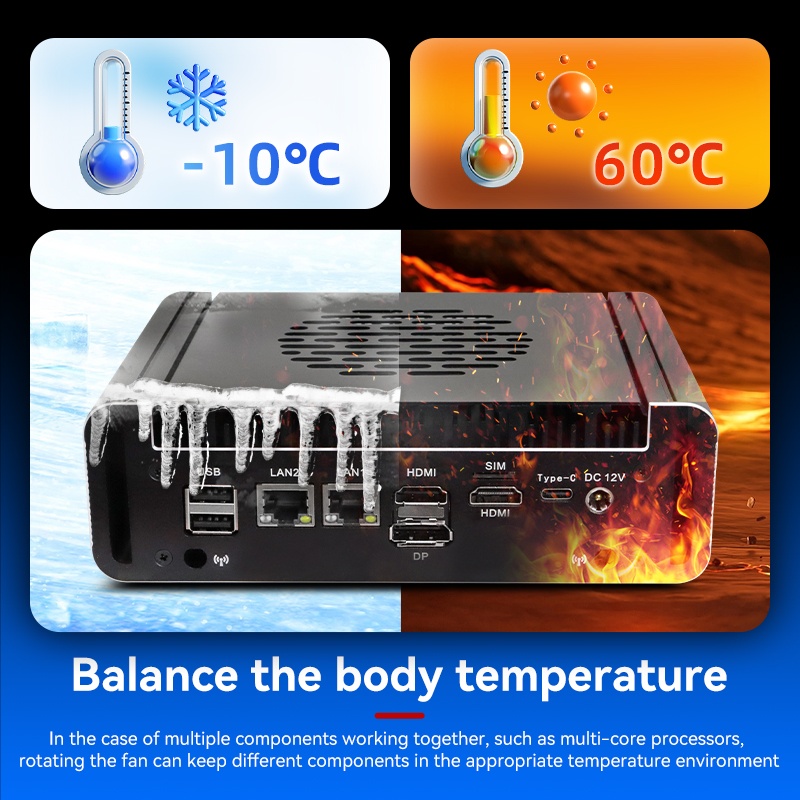
Deploying high-performance processors creates immediate thermal challenges. Factory environments typically force operators to place hardware inside heavily sealed NEMA or IP-rated enclosures to block airborne contaminants. These enclosures lack open ventilation. Heat generated by CPUs and GPUs pools rapidly inside the cabinet. If temperatures exceed critical thresholds, processors throttle their speed, causing software lag before eventually triggering a hard shutdown.
You must carefully analyze thermal management strategies before deploying an industrial cabinet server. Fanless designs present an excellent solution for low-power workloads. They utilize massive aluminum heat sinks to transfer heat directly out of the chassis via conduction, eliminating points of mechanical failure. However, edge AI systems utilizing 300-watt GPUs require ruggedized active cooling. You must ensure internal fans utilize dual ball bearings and remain isolated from external dust intake.
Common Mistake: Relying solely on internal server fans while ignoring ambient cabinet temperatures. Always calculate the total heat dissipation of all combined equipment inside the sealed enclosure to determine if external cabinet air conditioning units are necessary.
Manufacturing facilities suffer from notoriously "dirty" power. When heavy industrial motors or arc welders activate, they draw massive amounts of current. This sudden draw causes severe voltage sags across the local power grid, immediately followed by damaging voltage spikes. Standard power supplies cannot smooth out these aggressive fluctuations, resulting in abrupt server reboots or blown capacitors.
To mitigate dirty power risks, you must strictly specify industrial-grade redundant power supplies. Dual modules ensure that if one power unit fails from a voltage spike, the secondary unit instantly assumes the full load without interrupting production. Furthermore, investigate whether your application requires AC or direct DC power inputs. Many telecom and factory control panels run exclusively on 24V or 48V DC power, requiring specialized power distribution hardware.
Commercial hardware vendors frequently alter internal components to reduce manufacturing costs. They might change the network controller chip or memory brand every six months without notifying the end user. While acceptable in consumer markets, this practice creates disaster for ICS environments. Changes to the underlying hardware layer often trigger operating system crashes or force automation engineers to completely recertify the software stack.
You must partner with vendors who offer a strict, fixed Bill of Materials (BOM) policy. A fixed BOM guarantees that every single component remains identical throughout the product's entire lifecycle. Insist on a guaranteed availability window of 7 to 15 years. This longevity ensures that if a unit fails five years from now, you can drop a mathematically identical replacement node into the cabinet without reloading complex drivers or modifying your control software.
Before reviewing any technical specification sheets, you must clearly map out your exact environmental constraints and software payloads. Evaluate the physical dimensions of your existing cabinets. Measure the ambient temperature during peak summer operations. Understand your software needs accurately. If you plan to utilize hypervisors to run multiple Virtual Machines (VMs) for distinct control layers, you must secure adequate CPU core counts and expansive memory limits to prevent operational bottlenecks.
Never base critical infrastructure decisions purely on marketing brochures. Require verifiable environmental test reports from the vendor. Once you verify the baseline compliance, conduct rigorous on-site Proof of Concept (PoC) testing under peak operational load.
Install the evaluation unit inside the actual factory cabinet.
Run your heaviest software payloads, including high-resolution video streams and database queries.
Monitor the CPU temperatures continuously to check for thermal throttling.
Induce power interruptions to verify the seamless transition of redundant power supplies.
The right hardware partner acts as an extension of your engineering team. Partnering with a reputable Industrial Computer Manufacturer ensures deep custom configurations rather than just off-the-shelf boxes. Look for localized engineering support capable of assisting during complex deployments. Demand transparent Mean Time Between Failures (MTBF) data for every component.
Evaluation Category | Key Vendor Deliverables |
|---|---|
Engineering Support | Direct access to FAEs (Field Application Engineers), localized warranty repair. |
Customization | Ability to modify I/O panels, integrate proprietary PCIe cards, custom branding. |
Transparency | Detailed MTBF reporting, verifiable thermal test chamber documentation. |
Supply Chain | Strict fixed BOM guarantees, long-term 7-10 year component availability. |
Finding a reliable Industrial Computer Manufacturer is critical for the long-term success of your Industrial Control System. MeetNeng is a dedicated Industrial Computing Solutions Provider, ensuring that every Industrial Server and Rackmount Industrial PC we deliver meets the highest industry standards for resilience and performance.
Founded in 2008: Over a decade of proven expertise in engineering ruggedized hardware.
OEM & ODM Service: Fully customizable Rackmount Industrial PC designs tailored to your exact project constraints.
Industrial Computing Solutions Provider: Comprehensive hardware platforms designed for severe OT environments.
CE/FCC/RoHS Certified: Rigorously tested to ensure every unit meets strict global compliance and safety regulations.
Global Project Experience: Trusted by automation engineers and system integrators in manufacturing facilities worldwide.
Long-Term Product Supply Support: Strict BOM lock policies that guarantee mathematically identical replacements for years to come.
Specifying a purpose-built rackmount system for industrial control environments fundamentally acts as an exercise in rigorous risk management. When you invest in heavy-duty chassis structures, wide-temperature components, and redundant architectures, you directly ensure operational continuity. Consumer-grade IT equipment simply cannot survive the vibration, dust, and electrical instability native to the factory floor.
Your next step requires immediate action on the production floor. Audit your current control cabinet space to determine exact dimensional limits. Calculate your maximum thermal dissipation boundaries and inventory the legacy I/O protocols your machines still demand. Finally, consult with an industrial computing specialist to outline these specifications and configure a dedicated test unit for your facility.
A: Enterprise servers require clean, climate-controlled data centers. Industrial rackmount servers use ruggedized build materials to survive severe environmental tolerances like metallic dust, heavy vibration, and extreme temperature fluctuations. They also feature a fixed Bill of Materials (BOM) for long-term component longevity and provide native support for legacy industrial I/O protocols.
A: Your choice depends entirely on physical cabinet constraints and necessary PCIe expansion. Select a 1U chassis for simple routing in tight spaces. Use 2U for moderate storage and control tasks. Choose a 4U system when you need expansive vertical clearance to add machine vision frame grabbers or massive dual-slot GPUs.
A: Industrial software environments react highly sensitively to underlying hardware changes. A fixed BOM guarantees identical internal components over a 7 to 15-year lifecycle. This strict consistency ensures that deploying replacement parts or executing future rollouts won't trigger blue screens, driver conflicts, or require complete software recertification.
MeetNeng provides customized industrial rackmount servers for:
Factory Automation
SCADA Systems
Machine Vision
Edge AI Computing
Industrial IoT
Contact our engineering team today for OEM/ODM solutions and project consultation. Contact Us to secure the most reliable computing infrastructure for your operations.


