
Views: 0 Author: Site Editor Publish Time: 2026-09-22 Origin: Site


Picture a bustling factory floor. Airborne dust, atomized machine oils, and mandatory daily washdowns are simply part of the daily routine. In such unforgiving environments, standard consumer-grade computers fail almost instantly. They suffocate under thick layers of debris or short-circuit at the first sign of moisture. This inevitable hardware failure leads to agonizingly costly downtime, compromised production data, and endless replacement cycles.
Bridging the gap between high-performance computing and rugged physical durability, an IP65 industrial panel PC emerges as the ultimate operational safeguard. By understanding how these specialized panels block microscopic particulates and survive rigorous sanitation protocols, procurement specialists and facility managers can make informed decisions. These choices ultimately protect critical data and maintain seamless operational continuity.
When evaluating hardware for industrial deployments, looking beyond basic processing power is paramount. The physical resilience of the equipment often dictates its true lifespan. The Ingress Protection rating system provides an objective, standardized measurement of a device's ability to resist solid particles and liquid ingress.
The rating code consists of two primary digits. Each number represents a distinct level of environmental defense. To truly appreciate the durability of this hardware, we must look at what these specific metrics guarantee.
The first digit 6 evaluates protection against solid objects. A rating of 6 is the absolute highest standard for solid ingress, certifying that the front panel is completely dust-tight. Under rigorous vacuum testing protocols, absolutely no microscopic dust, powder, or airborne debris is permitted to breach the enclosure.
In addition, the second digit 5 measures defense against liquids. This number indicates robust protection against low-pressure water jets. Specifically, the panel must withstand water projected by a 6.3 millimeter nozzle from any angle. The test uses a flow rate of 12.5 liters per minute. The device must endure this without sustaining damage or allowing moisture to compromise the sensitive internal electronics.
While higher ratings like IP67 or IP69K certainly exist, they often carry significantly higher manufacturing costs. Those extreme ratings are primarily engineered for continuous underwater submersion or high-pressure steam cleaning. Conversely, a lower IP54 rating permits a small amount of dust to enter. This dust inevitably accumulates over time and triggers thermal failure.
Rating | Dust Protection Level | Liquid Protection Level | Ideal Manufacturing Application |
|---|---|---|---|
IP54 | Partial dust ingress allowed | Light splashes only | Clean control rooms, indoor logistics |
IP65 | Completely dust-tight | Low-pressure washdown jets | CNC machining, assembly lines, food packaging |
IP69K | Completely dust-tight | High-temp, high-pressure steam | Heavy meat processing, pharmaceutical washrooms |
For general manufacturing, CNC machining centers, and light washdown areas, this standard represents the most cost-effective and practical choice. It delivers absolute certainty against dust-induced short circuits while offering more than enough water resistance to handle routine shift-change cleaning procedures.
Achieving a genuinely dust-tight seal requires precise, intentional engineering. Standard monitors rely on active ventilation. This design choice is fundamentally incompatible with heavy industrial zones. Instead, the defense mechanisms of an industrial computer are built directly into its structural core.
Traditional computers manage internal heat by utilizing cooling fans that constantly draw in outside air. On a factory floor, this ambient air is heavily laden with particulate matter. Over the course of a few months, fans pull dirt, textile fibers, and abrasive metal shavings directly onto the motherboard. This conductive blanket traps heat, eventually causing the processor to throttle or fail entirely.
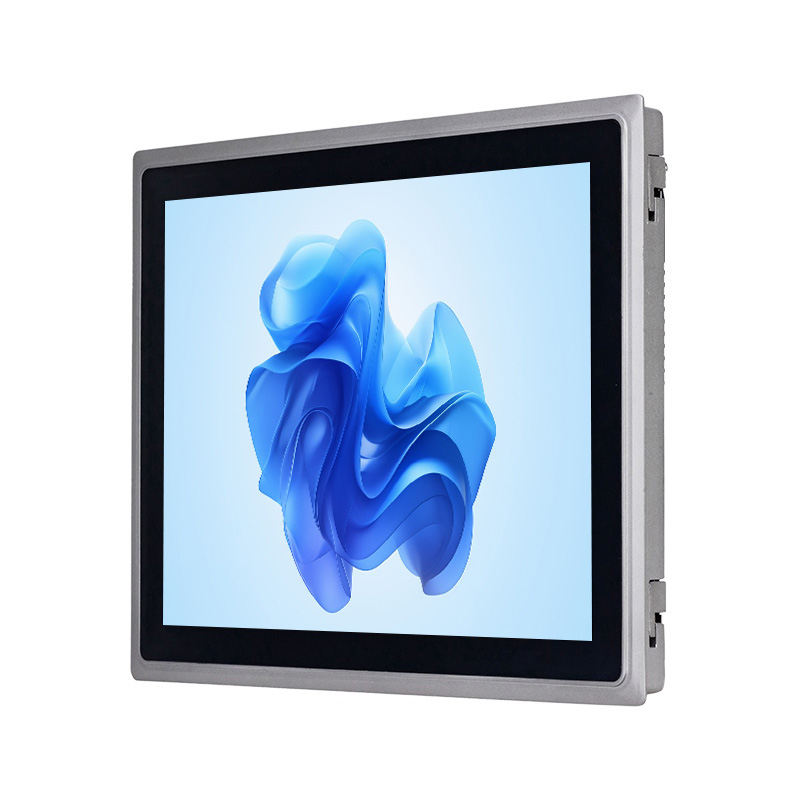
To eliminate this vulnerability, engineers deploy a sealed fanless panel PC architecture. Available in versatile sizes ranging from 10.4 to 21.5 inches, these systems physically block dust ingress at the source by removing ventilation holes entirely. Rather than relying on active airflow, these machines utilize passive thermal management. The outer chassis functions as a massive heat sink. Thermal pads transfer heat from the internal CPU directly to the metal enclosure, dissipating it safely into the surrounding environment.
Older industrial displays frequently featured a stepped bezel design, where the outer frame sat slightly higher than the actual display screen. From a practical standpoint, this created a physical ledge along the perimeter of the monitor. In dusty workshops, this narrow crevice becomes a magnet for debris, machine oil, and bacterial growth. Cleaning it becomes exceptionally tedious.
Modern interfaces utilize a seamless, true-flat front design. Edge-to-edge glass ensures there are no recesses or raised lips where particulates can hide. This perfectly smooth surface allows operators to wipe away accumulated grime in a single, fluid motion. Consequently, maintenance teams drastically cut down the time required for daily sanitation.
In highly specialized environments, such as aerospace machining shops or electronic component manufacturing, airborne dust is not merely an insulator. It is highly conductive. Microscopic metallic shavings floating in the air can easily bridge the microscopic gaps between circuits on a logic board. This leads to immediate, catastrophic hardware failure.
Through the use of industrial-grade rubber gaskets, silicone sealants, and precision-milled enclosures, these front panels block micro-particulates entirely. By ensuring the front interface is hermetically sealed against the mounting cabinet, the sensitive internal computing core remains pristine. This holds true regardless of how polluted the production floor air becomes.
Looking at broader manufacturing trends, recent industry analyses reveal a significant shift toward hyper-strict hygiene compliance. Driven by post-pandemic safety regulations and automated food-safety tracking, facility managers are now mandated to implement more aggressive, high-frequency sanitation protocols. As a direct result, the industrial hardware market is experiencing a massive migration away from legacy monitors. Factories now demand specialized interfaces that can endure harsh chemical exposures without degrading.
During routine shift handovers, facility maintenance teams often rely on hoses to wash down workstations. Standard electronics would instantly short-circuit under these wet conditions. The liquid protection rating specifically guarantees that operators can safely spray the front of the display with water to remove accumulated organic residue or coolant.
Because the unit is tested to block moderate water pressure, operators can confidently use standard washdown hoses. The industrial-grade silicone gaskets ensure moisture never reaches the internal LCD matrix or the motherboard.
Water alone is rarely enough to achieve industrial sanitation. Cleaning regimens frequently involve mild solvents, heavy degreasers, isopropyl alcohol, or specialized chlorine-based antibacterial agents. The materials selected for a high-quality front panel are chosen specifically for their exceptional chemical resilience.
The front enclosures are typically constructed from die-cast aluminum with a protective powder coating, or from SUS304 and SUS316 stainless steel. These robust materials resist corrosion, rust, and bacterial adhesion. Furthermore, the front touch glass is chemically strengthened. This prevents etching or clouding when repeatedly wiped down with harsh ammonia solutions, ensuring long-term compliance with strict hygiene standards.
A notorious operational challenge in wet environments is erratic touchscreen behavior. Standard capacitive screens often register splashing water droplets as finger inputs. This leads to ghost touches or, worse, accidental machine commands during the cleaning process.
An advanced dust resistant touch panel computer overcomes this obstacle through sophisticated firmware algorithms. High-end Projected Capacitive touch controllers are calibrated with water-rejection technology. The controller intelligently differentiates between the electrical signature of a localized water droplet and the broader capacitive footprint of a human finger. As a result, the interface remains safely unresponsive to splashing water, yet instantly registers intentional operator inputs once the screen is wiped down.
Procuring the right hardware requires looking deeper than the basic environmental rating. The internal architecture and external material science of the unit dictate its longevity and reliability in the field. Procurement teams must critically assess several structural components before making an investment.
The physical housing of the panel PC serves as the primary barrier against environmental hazards. It directly impacts thermal management and corrosion resistance.
Die-cast aluminum offers exceptional thermal conductivity and is highly resistant to physical impact. It is the go-to choice for CNC machining, automotive manufacturing, and warehousing logistics. In contrast, stainless steel reigns supreme for environments burdened with strict sanitary requirements, such as meat processing plants or pharmaceutical cleanrooms. It provides maximum corrosion resistance and withstands highly acidic cleaning chemicals.
Selecting the optimal interface method depends entirely on the specific operational environment and what the operator will be wearing on their hands.
Projected Capacitive screens feature a multi-touch glass surface that is highly resistant to scratches and abrasions. Because the conductive grid is protected behind heavy-duty glass, dirt cannot interfere with the touch mechanism. Modern industrial screens excel in wet cleaning scenarios and easily recognize inputs from users wearing thin latex or nitrile gloves.
Resistive touch screens rely on physical pressure rather than electrical capacitance. This makes them entirely immune to water droplets and heavy dust buildup. They remain the preferred choice for operators who must wear thick, heavy-duty leather or Kevlar work gloves on the factory floor.
Industrial software, such as complex SCADA systems, 3D CAD rendering, or real-time machine vision processing, requires significant computational power. However, high-performance processors naturally generate substantial heat. Because a fanless design relies on passive cooling, balancing processing needs with thermal limits is vital.
For applications demanding robust processing without compromising the environmental seal, embedded units equipped with Intel Core i5 or i7 processors provide the necessary horsepower. These specialized units utilize advanced heat-pipe technology and low thermal design power architecture. They safely dissipate heat generated by powerful Intel processors, even when enclosed in unventilated factory cabinets.
While industrial hardware is built for extreme durability, adhering to proper maintenance protocols ensures maximum lifespan. It also prevents accidental damage that could void warranties.
Routine maintenance should be performed using materials that clean effectively without degrading the industrial sealants. Always use soft, non-abrasive microfiber cloths to wipe away dust and liquids. This prevents micro-scratches that can accumulate and reduce screen clarity over time.
For sanitizing the interface, 70 percent isopropyl alcohol wipes are highly recommended. They kill bacteria rapidly, cut through light industrial oils, and evaporate quickly without leaving a conductive residue. For general dirt and grime, a simple solution of mild detergent and warm water is highly effective and perfectly safe for the silicone gaskets.
Understanding the limitations of your equipment is just as critical as knowing its strengths. Facility staff must be trained on specific practices to avoid.
Avoid high-pressure washers. The standard protects against low-pressure jets. Using a high-pressure power washer or steam cleaner can force water past the rubber seals and destroy the screen. Additionally, avoid abrasive scrubbers like steel wool or harsh scouring pads. These will permanently scratch the protective coating on the touch glass, severely reducing touch sensitivity.
Finally, do not pool water behind the panel. It is vital to remember that a front panel rating implies exactly that—only the front is protected. Operators must ensure water does not pool at the unsealed rear of the monitor where the input and output ports are located.
Selecting the optimal hardware requires a systematic evaluation of your facility's unique environmental variables, computational requirements, and physical infrastructure.
Begin by conducting a thorough audit of the specific hazards present in the installation area. Is the dust in the environment dry, like sawdust, or wet and sticky, like flour mixed with high humidity? Will the screen face direct liquid splashes, or merely ambient moisture? If the primary hazard is dry dust, a standard aluminum front panel is highly cost-effective. However, if the area involves corrosive chemical splashes, upgrading to a stainless steel enclosure becomes a necessary investment.
The integrity of a front panel seal relies heavily on the method of installation.
Panel mounting is the most secure method. The computer is inserted into a precise cutout in a control cabinet. A waterproof gasket seals the front bezel against the outside of the cabinet door. This setup perfectly protects the unrated rear of the computer inside the dry, sealed cabinet.
In contrast, if you intend to mount the PC on a swing arm in an open environment using a VESA mount, the back of the unit will be completely exposed. In a dusty or wet environment, a front-only rating is insufficient for VESA mounting. You must upgrade to a fully enclosed waterproof computer to protect the rear ports.
No. The rating strictly guarantees protection against dust ingress and low-pressure water jets directed from any angle. It is not engineered for submersion. If your operational environment requires equipment to be temporarily or permanently submerged in liquids, you must procure hardware with a higher waterproof rating.
Not necessarily. The designation specifies that only the front bezel and the touchscreen interface are sealed against dust and water. The rear chassis, which houses the ports, ventilation nodes, and power connections, is typically unrated. To achieve full protection, the unit must be properly panel-mounted into a sealed control cabinet.
Traditional active cooling systems use fans to pull ambient air across internal components to dissipate heat. In industrial settings, this process inhales airborne dust, metal shavings, and debris. This particulate matter coats motherboards, acts as a thermal insulator causing overheating, and can trigger electrical short circuits. Fanless architectures utilize passive cooling via external heat sinks, allowing the chassis to remain completely sealed.
Yes, but compatibility depends entirely on the underlying touch technology. Resistive touchscreens are pressure-sensitive and will register inputs from any physical object, including heavy leather or Kevlar gloves. Modern capacitive screens rely on electrical currents and are generally optimized for bare fingers or thin nitrile gloves, though advanced controllers can be specifically calibrated for medium-thickness work gloves.
Due to the absence of moving parts and the ruggedized fanless architecture, these units typically boast a lifespan of five to seven years, even in demanding factory conditions. Routine maintenance and proper installation are key factors in maximizing this operational longevity.
Yes, provided they utilize optical bonding technology. In facilities subject to frequent temperature fluctuations, standard displays can fog up due to the air gap between the touch glass and the internal LCD panel. Premium industrial units eliminate this issue by injecting an optical-grade resin between the layers, removing the air gap and completely preventing internal condensation.
Ultimately, deploying ruggedized industrial hardware is not merely a luxury, but a fundamental necessity for minimizing downtime in harsh environments. The strategic combination of a sealed fanless architecture and a true-flat touch screen delivers the ultimate defense against dust, water, and debris. By carefully evaluating your operational hazards and processing needs, you can deploy a computing solution that thrives exactly where standard electronics fail. To explore a comprehensive range of configurations tailored to your specific factory requirements, visit https://www.meetipc.com and secure your production continuity today.


