


The GW200 is a fanless industrial PC built for one job: sitting in a sealed cabinet for years with no fan to seize. A 15 W Intel Core i5-5200U or i5-7200U is bolted to a solid aluminium block, and the 267 × 143 × 50 mm body is the heatsink — ribbed on top, sealed on the sides, with no vent to pull dust onto the board and no filter to clean on a maintenance round. Memory is 4–16 GB DDR3 or DDR4, storage is SATA from 128 GB to 1 TB, SSD or HDD, and the input is DC 12 V.
The front panel carries the ports a machine builder actually wires: HDMI at 1080p, two serial ports, four USB 3.0, two Gigabit Ethernet ports, audio in and out, the DC jack, a power button, and two recessed pinholes for one-key recovery and clearing CMOS. The rear carries the cabinet side of the job: an 8-channel GPIO block with a remote power terminal, an external CR2032 battery slot, a SIM slot for 4G, two more serial ports and four USB 2.0. Two antennas and four holes in the base flanges finish the outside.


Heat leaves the GW200 through the metal. The processor, chipset and memory sit against the inside of a machined aluminium block whose outer face is a finned heatsink, so what you see on top of the box is the entire thermal path — no fan, no airflow plan, and no filter that loads up with swarf and stops working on a Friday night.
That buys three things a fan cannot: silence, a dustproof interior, and no bearing to fail after 20,000 hours. The trade-off is honest — a passive enclosure of this size dissipates around 15–25 W, so there is no room inside for a discrete GPU or a frame grabber. If the project needs add-in cards, the GW200 is the wrong product and the IPC-810 rackmount chassis is the right one. Operating range is −10 °C to 60 °C; mount it so the fins are not buried against a wall or sitting above a heat source.

The I/O is dense because a control cabinet needs ports, not a desktop. The front panel carries HDMI, two serial ports, four USB 3.0, two Gigabit Ethernet ports, audio in and out, the DC jack and the power button; the rear carries two more serial ports, four USB 2.0, the GPIO block, the SIM slot and the battery slot. Eight USB ports in total, split so that cameras and USB sticks use the 3.0 ports on the front while licence dongles and a service keyboard stay on the 2.0 ports at the back where they are not in the way.
Dual GbE is the detail buyers ask about most: one port on the machine control network, one on the plant IT network, with no switch inside the cabinet. Serial is where specifications diverge — tell us whether the field devices are RS-232, RS-422 or RS-485 and how many ports the build needs, and we will confirm the port map before the order; some configurations carry six. HDMI is the only display output and runs at 1080p, so a dual-screen station needs a different model.

Two connectors on the rear panel do the work that usually ends up on a DIN rail beside the PC. The first is an 8-channel GPIO terminal — four digital inputs and four digital outputs — for reading a door switch, a stack light or a proximity sensor and for driving a relay or a solenoid from the same unit that runs the HMI.
The second is a two-pole remote power terminal, so the 12 V feed lands on a screw terminal instead of a barrel jack and a length of loose cable in a cabinet that has to pass an inspection. Both sit on pluggable blocks: the cabinet is wired before the PC arrives, and commissioning becomes a matter of plugging in. Send us the signal levels, and whether the outputs must sink or source, and we will confirm the circuit before the build.

Every industrial PC keeps a coin cell alive for the real-time clock and the CMOS settings. On most of them, replacing that cell means opening the case — which means pulling the unit out of the cabinet, breaking the seal, and burning an hour of production time for a component that costs a dollar.
On the GW200 the CR2032 sits in a slot on the rear panel. Slide the old cell out, drop a new one in, slide it back: no screwdriver, no lid, no downtime beyond resetting the clock. The same design is why the unit travels by air without argument — the cell can be removed for shipment without anyone opening the chassis. It is one of the patents our R&D team holds, and it is the feature maintenance departments notice first.

Two processors are offered, both 15 W dual-core parts: the i5-5200U from the 5th generation, which pairs with DDR3, and the i5-7200U from the 7th, which pairs with DDR4. Memory is 4, 8 or 16 GB; storage is SATA, 128 GB to 1 TB, SSD or HDD. For a fanless box in a hot cabinet we quote an SSD by default — no moving parts, a wider temperature margin, and no head to park when the machine is powered down at the end of a shift.
Choose the generation for the software, not for the benchmark. If the application is a Windows 7 image from 2012, say so at quotation: Intel dropped official Windows 7 support with the 7th generation, and the 5200U build is usually the answer that keeps the USB 3.0 ports working. If the project is a fresh Linux build, or a modern Windows image supplied by your integrator, the 7200U is the better buy.

A SIM slot on the rear panel takes a standard card from outside, so a modem can be fitted or swapped on site without removing the unit or opening the chassis. Two antennas mount on the front and rear of the heatsink. Dual-band WiFi is available as an alternative or an addition, for cabinets where pulling a network cable is the expensive part of the job.
This is the difference between an edge box and a desktop: telemetry from a remote pump station, an AGV that has to stay associated while it crosses the aisle, or a kiosk in a building where IT will not run a drop. Tell us the carrier and the band and we will confirm the module — and if the site has good cable access and no coverage problem, we will say so and quote the plain unit instead.
The unit is 267 mm long, 143 mm wide and 50 mm high, and weighs about 2.5 kg. Four mounting holes sit in flanges at the base corners, so it screws to a backplate, a machine frame or a VESA plate without a separate bracket. Fifty millimetres means it fits cabinets where a 4U chassis will not, and it fits behind a panel without fouling the door.
Mount it with the finned face vertical or free, not flat against a sealed surface, and leave 50 mm of clear air above the fins — a passive heatsink with a wall on top of it is a 60 °C ambient problem waiting to happen. Power is DC 12 V, through the front jack or the rear remote terminal. If the cabinet runs hot, tell us the measured ambient temperature and we will advise on orientation and derating before the order rather than after.

The aluminium front panel takes a laser-engraved logo, the BIOS boot screen carries your brand, and the operating system image — Windows or Linux, with your drivers and your application — is installed and burned in before packing. Industrial protective packaging with your label closes the box.
Because the chassis is machined rather than moulded, a change of connector mix, front-panel layout or finish does not need a tooling budget, but it does need a drawing. Send the requirement list — CPU, memory, storage, port count, logo, OS image — and we will return a configuration, a port map and a lead time. Single units are available for evaluation; OEM branding starts at the quantity agreed for your configuration.

The GW200 suits any project that needs a sealed, low-power x86 box with real industrial I/O inside a cabinet or on a machine:
· Industrial automation — PLC and HMI hosts, cell controllers, SCADA nodes
· Machine vision — USB3 camera stations, code readers, defect logging
· IoT edge gateway — protocol conversion, data collection, telemetry over 4G
· Smart logistics — AGV and AMR controllers, warehouse terminals
· Self-service and kiosk — ticketing, access control, queue systems
· Energy and utilities — remote monitoring in unattended cabinets
Where the project needs a frame grabber, a motion control card or a discrete GPU, the GW200 runs out of slots by design — that is the IPC-810's job, and we will point you there rather than sell you a box that throttles. Send us the application and the peripheral list and we will tell you which of the two fits.

Every unit is assembled, powered, burned in and function-tested before packing, with each port exercised: serial loopback, both Ethernet ports, all eight USB, the HDMI output and every GPIO channel. CE and RoHS documentation is issued against the exact bill of materials of the configuration you order, because a different radio module or power supply changes the test scope — ask at quotation and we will send the certificate numbers for that build.
The box contains the GW200, a DC 12 V power adapter, two antennas where a radio is fitted, and the mounting screws. Standard warranty is one year on the complete unit and three years on hardware, with a seven-day return window for units that do not match the agreed specification; spare units and advance replacement are available for series projects. Stocked configurations ship within 72 hours, and built-to-order units follow the lead time on the quotation.
Item | Specification |
Model | GW200 |
Form factor | Fanless industrial PC, full aluminium ribbed passive heatsink |
Processor | Intel Core i5-5200U (5th Gen) / Intel Core i5-7200U (7th Gen), 15 W TDP |
Memory | DDR3 / DDR4 — 4 GB / 8 GB / 16 GB |
Storage | SATA 128 GB / 256 GB / 512 GB / 1 TB, SSD or HDD |
Graphics | Intel integrated HD Graphics |
Display | 1 × HDMI, 1080p |
Ethernet | 2 × GbE (RJ45), dual LAN |
USB | 4 × USB 3.0 (front) + 4 × USB 2.0 (rear) — 8 ports in total |
Serial | 2 × COM front + 2 × COM rear; up to 6 ports in some configurations |
GPIO | 8-channel — 4 DI / 4 DO, pluggable terminal block |
Remote power | 2-pole screw terminal for DC 12 V input |
Wireless | 1 × external SIM slot (4G LTE module optional); dual-band WiFi optional; 2 × antenna |
Audio | 1 × line-out, 1 × mic-in |
Reset / recovery | 1 × one-key recovery (REC), 1 × clear CMOS pinhole |
RTC battery | External tool-free slot, CR2032, hot-swap in about 3 seconds |
Watchdog | Hardware watchdog; auto power-on after power failure |
Power input | DC 12 V |
Cooling | Fanless, passive — full aluminium ribbed heatsink |
Operating temperature | −10 °C to 60 °C |
Operating system | Windows 7 / 8 / 10 / 11, Linux |
Mounting | 4 × screw holes on base flanges — wall, panel or VESA |
Housing | Aluminium alloy body, blue anodised front panel |
Weight | Approx. 2.5 kg |
Dimensions | 267 × 143 × 50 mm (L × W × H) |
About Meetneng
Meetneng (Foshan Lineng Electronic Equipment Co., Ltd.) is an industrial computing manufacturer based in Shunde, Foshan, Guangdong, China. Founded in 2008, the company designs, builds and supports industrial panel PCs, fanless industrial PCs, embedded computers, rackmount servers, industrial displays and rugged tablets for automation projects worldwide.
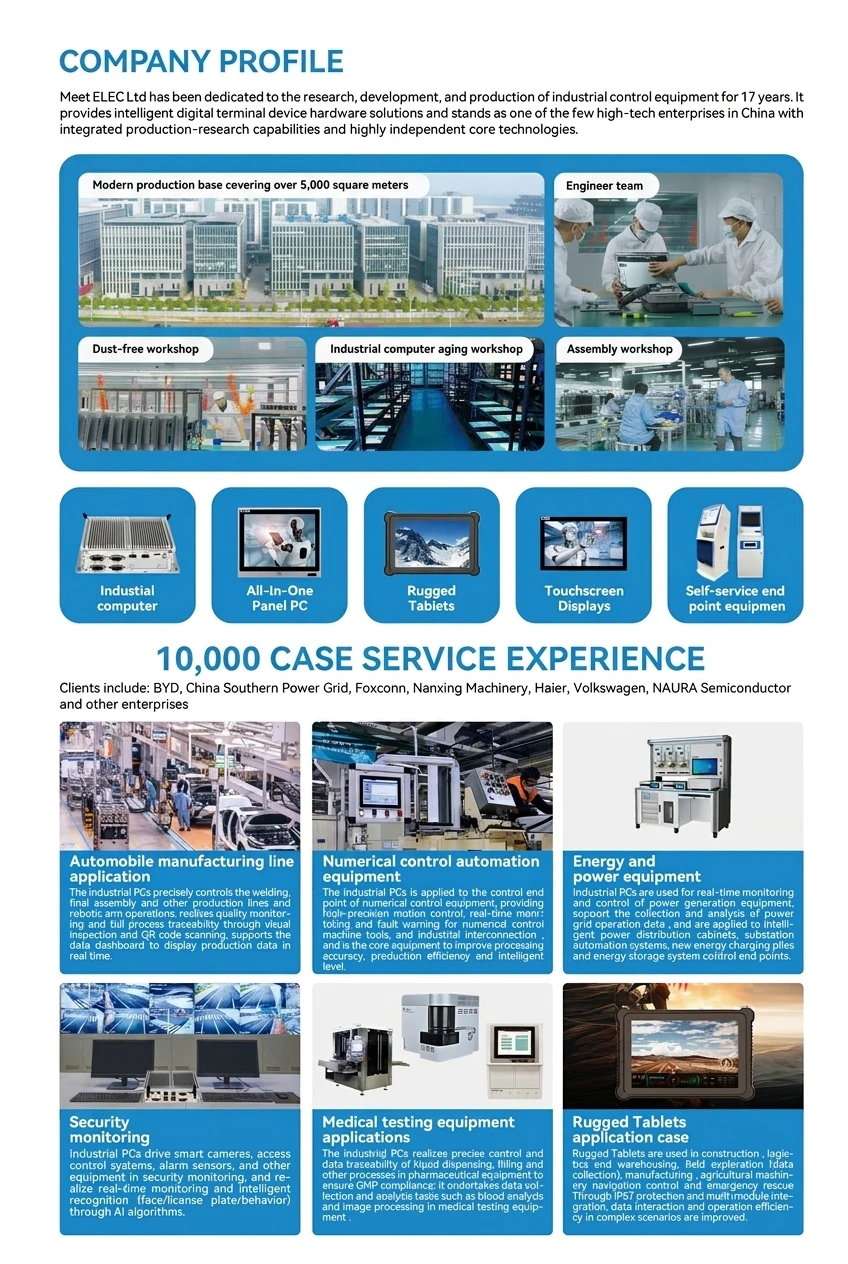
Our 5,000 m² production base runs an ISO 9001 quality system with a 12-step inspection process covering incoming components, assembly, burn-in, function testing and final packing. Units are built from globally sourced components, and our field repair rate is kept below 0.5%.
Meetneng is backed by the Vinwo Electronics Group and employs a 20-plus member R&D team holding more than 30 patents in industrial computer and display design. More than 30 certificates cover safety, EMC, environmental compliance and design patents, including CE, FCC, LVD and RoHS; a catalogue of over 1,000 product types is built on that base.

Meetneng products are used in factory automation, smart manufacturing, machine vision, transportation, energy, medical equipment and industrial IoT. Products are exported to more than 100 countries and regions and are in service with over 15,000 customers, including Haier, Gree, BYD, Hikvision, Foxconn and CRRC. That customer base is the reason our configurations are standardized rather than improvised: the same chassis, mounting pattern and BIOS behaviour are already deployed in production environments, so a new project starts from a proven baseline instead of a prototype.
OEM and ODM are core to how we work rather than an add-on service. Our engineering team adjusts display size, processor platform, memory and storage, interface layout, enclosure structure, operating system image and branding to match a specific machine or project — from a single evaluation unit to series production, with drawings for approval before tooling. The team also meets integrators and distributors at international industrial fairs, so a specification can be discussed against hardware rather than a datasheet.

Every project is supported by pre-sales configuration advice, testing before shipment, and after-sales remote diagnostics with spare-parts supply. Shipments go out by express, air and sea through DHL, FedEx, UPS, TNT and EMS, packed in double-wall cartons with foam and, for series orders, palletised and shrink-wrapped for container loading. If you are standardizing a plant, retrofitting an existing machine or sourcing a private-label industrial PC, send us the application and peripheral list — we will propose a configuration and a sample schedule.


