BPC-101 Fanless Industrial PC
The BPC-101 is a fully sealed, fanless industrial computer built for machines that run all day. Its extruded aluminum chassis acts as the heat sink, so there is no fan, no filter and no intake to clog with dust. Inside, an Intel Core i5 processor pairs with 4–8 GB RAM and a 128–256 GB SSD, with two Gigabit LAN ports, six RS-232 serial ports (COM2 optionally RS-485), six USB ports, and HDMI + VGA outputs for dual independent displays. Rated from -10 °C to 60 °C and 1.65 kg light, it mounts on a wall, inside a cabinet or on a desk. OEM branding, I/O layout and OS image are configurable.


The BPC-101 is a fully enclosed industrial PC with no fans, no vents and no moving parts. The whole chassis is one piece of extruded aluminum that doubles as the heat sink, so heat leaves the enclosure through the metal walls instead of through an air intake. That single design decision removes the two most common causes of industrial PC failure: dust pulled in by a fan, and a fan that eventually stops spinning.
Inside the 234 × 211 × 52 mm housing sits an Intel Core i5 processor with 4 GB or 8 GB of memory and a 128 GB or 256 GB SSD, two Gigabit LAN ports, six RS-232 serial ports, six USB ports, and HDMI plus VGA outputs that can drive two screens at once. The unit is rated from -10 °C to 60 °C, weighs 1.65 kg, and can be wall-mounted, embedded in a machine cabinet or simply placed on a desk.

Most industrial PC failures are not electronic — they are thermal and mechanical. A conventional mini PC pulls cooling air through a fan and a filter; on a shop floor that air carries metal dust, oil mist and humidity straight onto the motherboard. The fan bearing is usually the first component to fail, and when it does, the machine overheats silently.
The BPC-101 removes the entire airflow path. The chassis is a single sealed aluminum body with cooling fins on the top and sides; heat is conducted from the CPU to the aluminum wall and radiated into the surrounding air. There is no filter to clean, no fan to replace, and no positive air pressure pulling contaminants inside. In practice this means a quieter unit, a lower maintenance cost, and a service life that is limited by the electronics rather than by a 20-cent bearing.

The housing is extruded aluminum alloy with a black anodized finish, available in silver gray or black to match the machine or cabinet it goes into. Because the chassis is a structural part rather than a folded steel shell, it resists compression and impact, and the sealed body keeps dust and corrosive mist away from the board. The front panel carries only the four USB 2.0 ports, COM1, COM2 and a metal power switch — nothing that needs a filter or a vent.
For equipment that vibrates — conveyors, pumps, machine tools, vehicle-mounted systems — a fanless, screw-fastened aluminum body has no moving parts to shake loose and no fan connector to work free.

The BPC-101 is specified for -10 °C to 60 °C operating temperature, -20 °C to 70 °C storage, and 5–95% relative humidity without condensation. It is designed for continuous operation rather than office hours: the same unit that runs a shift report in a warehouse in winter can run an inspection station next to a furnace in summer, with no heater, no air conditioner and no additional enclosure.
If your application is outside that envelope — a freezer room at -30 °C, or an enclosure that heats up above 60 °C — tell us the actual ambient temperature and duty cycle; we can quote a wide-temperature configuration instead of you discovering the limit in the field.

The port layout is what separates an industrial computer from a small desktop. The BPC-101 front panel carries 4 × USB 2.0, COM1, COM2 and the power switch. The rear panel carries DC 12 V input, HDMI, VGA, 2 × USB 3.0, 2 × Gigabit Ethernet (RTL8111H), COM3 to COM6, line-out, mic, two antenna connectors and a mini-PCIe slot.
That combination covers most machine-retrofit jobs without adding adapters: six RS-232 channels for scales, barcode scanners, PLCs, servo drives, temperature controllers and legacy meters; COM2 can be configured as RS-485 for a two-wire bus; two independent LAN ports let you keep a machine network physically separate from the plant or office network; and the mini-PCIe slot plus built-in WiFi (dual antenna, 5G optional) covers sites where cabling is not practical.

Two standard configurations are available. The first pairs an Intel Core i5-3210M with 4 GB memory and a 128 GB SSD; the second pairs an Intel Core i5-8250U with 8 GB memory and a 256 GB SSD. Other processors from the same platform — including Celeron J1900/J1800 and Core i3/i7 options — can be quoted on request, so the same chassis can be standardized across a plant with different performance needs.
Storage is deliberately split across two devices: one mSATA SSD for the operating system and one 2.5" SATA bay for a larger data drive. That lets you keep the OS on fast, reliable flash while storing images, logs or recipe files on a field-replaceable SATA disk — and it means a storage upgrade does not require reinstalling Windows.

HDMI and VGA outputs can run in synchronous or asynchronous mode, so one BPC-101 can drive an operator screen and a separate customer-facing or control-room monitor at the same time. Typical use: an HMI on the machine and a mirrored status board on the wall, or a control interface plus a live camera feed for inspection.

For unattended cabinets, the BPC-101 can be configured in BIOS to power on automatically when mains power returns — useful after a plant-wide power cut, when nobody is on site to press a button. The metal front switch is a deliberate design choice on machines where an accidental shutdown costs a production batch.
Mounting brackets are part of the chassis: 222 × 140 mm hole pattern with 6 × Ø4.5 mm holes, so the unit can be screwed to a wall, bolted inside a control cabinet, or stood on a desk with the brackets as feet. At 234 × 211 × 52 mm and 1.65 kg, it fits where a standard IPC chassis will not.


• CNC and machine tools — embedded controller, DNC terminal, tool-setting station
• Machine vision and inspection — camera host with dual LAN for camera network isolation
• Production lines and workshops — station terminal, Andon display driver, data collection
• Monitoring and control rooms — dual-display SCADA client, 24/7 logging
• Medical and laboratory equipment — quiet, sealed, wipe-down friendly
• Commercial and office equipment — kiosk controller, digital signage, meeting-room PC

Because the chassis, board and I/O are ours, most requests are a configuration change rather than a new project. Typical options: processor and memory, storage size and partition, COM count and RS-485 pinout, additional LAN or USB, WiFi/4G module, enclosure color (silver gray or black), silkscreen logo, BIOS boot logo, pre-installed OS image with your application, and retail packaging with your brand.
Send us the application description, the peripheral list and the target quantity; we will come back with a configuration, a drawing for approval and a sample schedule.

The BPC-101 is produced in an ISO 9001 certified facility with 12 inspection nodes between incoming components and final packing, and our field repair rate is kept below 0.5%. Units are tested individually before shipment, not sampled.
Electrical safety and electromagnetic compatibility documentation — CE, FCC, LVD and RoHS — is available for the industrial PC range, and the declaration of conformity for your exact configuration is supplied with the shipment so it can be filed with your own machinery documentation. Our engineering team holds more than 30 patents on industrial computer and display designs, covering enclosure structure, thermal design and interface layout.
If your project requires an explosion-proof or marine-classified unit, tell us the classification and the installation zone at the quotation stage — certification scope is model-specific, and we will confirm in writing which model and certificate number applies before you order.
Every unit is powered on and tested before packing, and orders normally ship within 72 hours of receipt. A 30-day trial is available for evaluation units. Hardware coverage is one year on the complete unit plus three years on hardware, with remote diagnostics and spare-parts supply from the factory.

Item | Specification |
|---|---|
Model | BPC-101 |
Processor | Intel® Core™ i5-3210M / Intel® Core™ i5-8250U (other CPUs on request) |
Memory | 4 GB / 8 GB |
Storage | 128 GB / 256 GB SSD; 1 × mSATA SSD slot + 1 × 2.5" SATA HDD bay |
LAN | 2 × RTL8111H Gigabit Ethernet |
Serial ports | 6 × RS-232 (COM2 optional RS-485) |
USB | 6 × USB (4 × USB 2.0 front, 2 × USB 3.0 rear) |
Display | 1 × HDMI, 1 × VGA — dual independent display, synchronous / asynchronous |
Other interfaces | 1 × Line-out, 1 × MIC, 1 × mini-PCIe, built-in WiFi (dual antenna, 5G optional) |
Operating system | Windows 7 / Windows 10 / Linux |
Power input | DC 12 V; external AC 110–220 V adapter |
Dimensions | 234 × 211 × 52 mm (W × D × H, including brackets) |
Mounting holes | 222 × 140 mm pattern, 6 × Ø4.5 mm |
Gross weight | 1.65 kg |
Installation | Embedded / wall-mounted / desktop |
Operating temperature | -10 °C to 60 °C |
Storage temperature | -20 °C to 70 °C |
Relative humidity | 5–95%, non-condensing |
Chassis | Full aluminum alloy, fanless passive cooling; silver gray or black |
Quality system | ISO 9001, 12 inspection nodes, repair rate below 0.5% |
Certification | CE, FCC, LVD, RoHS (declaration of conformity supplied with each shipment) |
Patents | 30+ patents held by the R&D team |
Warranty | 1 year complete unit + 3 years hardware |
CPU | LAN ports | Memory slots / max | Storage interface |
|---|---|---|---|
Intel Celeron J1800 | 1 | 1 × DDR3 / 8 GB | mSATA |
Intel Celeron J1900 | 2 | 1 × DDR3 / 8 GB | mSATA |
Intel Core i5-3210M | 2 | 1 × DDR3 / 8 GB | mSATA |
Intel Core i3-5005U | 2 | 2 × DDR3 / 16 GB | mSATA |
Intel Core i5-5350U | 2 | 2 × DDR3 / 16 GB | mSATA |
Intel Core i7-5650U | 2 | 2 × DDR3 / 16 GB | mSATA |
Intel Core i5-6300U | 2 | 2 × DDR3 / 16 GB | M.2 |
Intel Core i3-7100U | 2 | 2 × DDR3 / 16 GB | M.2 |
Intel Core i5-7300U | 2 | 2 × DDR3 / 16 GB | M.2 |
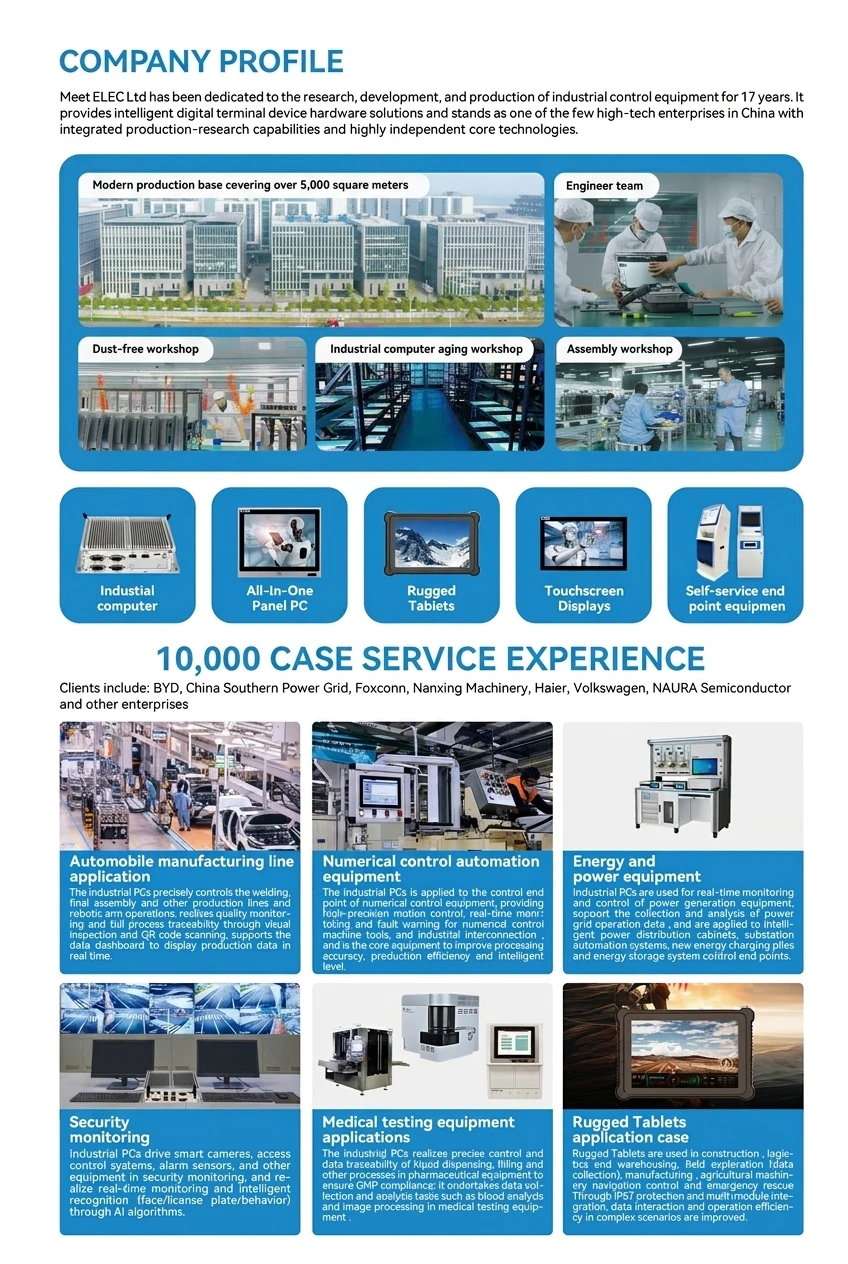
Meetneng (Foshan Lineng Electronic Equipment Co., Ltd.) is an industrial computing manufacturer based in Shunde, Foshan, Guangdong, China. Founded in 2008, the company designs, builds and supports industrial panel PCs, fanless industrial PCs, embedded computers, rackmount servers, industrial displays and rugged tablets for automation projects worldwide.
Our 5,000 m² production base runs an ISO 9001 quality system with a 12-step inspection process covering incoming components, assembly, burn-in, function testing and final packing. Units are built from globally sourced components, and our field repair rate is kept below 0.5%.
OEM and ODM are core to how we work rather than an add-on service. Our engineering team adjusts display size, processor platform, memory and storage, interface layout, enclosure structure, operating system image and branding to match a specific machine or project — from a single evaluation unit to series production, with drawings for approval before tooling.
Meetneng products are used in factory automation, smart manufacturing, machine vision, transportation, energy, medical equipment and industrial IoT. Every project is supported by pre-sales configuration advice, testing before shipment, and after-sales remote diagnostics with spare-parts supply.
Meetneng is backed by the Vinwo Electronics Group and employs a 20-plus member R&D team holding more than 30 patents in industrial computer and display design. The 5,000 m² factory follows ISO 9001 with 12 inspection nodes and produces a catalogue of over 1,000 product types, supported by more than 30 certificates covering safety, EMC, environmental compliance and design patents.
Products are exported to more than 100 countries and regions and are in service with over 15,000 customers, including Haier, Gree, BYD, Hikvision, Foxconn and CRRC. That customer base is the reason our configurations are standardized rather than improvised: the same chassis, mounting pattern and BIOS behaviour are already deployed in production environments, so a new project starts from a proven baseline instead of a prototype.
If you are standardizing a plant, retrofitting an existing machine or sourcing a private-label industrial PC, send us the application and peripheral list — we will propose a configuration and a sample schedule.