BPC-103 is a 55 mm thin industrial PC built around processors designed in China: Zhaoxin U-series (x86), Phytium Tengrui D2000 (ARM64) or Loongson 3K3000 (LoongArch). It brings two Gigabit LAN ports, HDMI and VGA dual display, DDR4 memory up to 64 GB, an M.2 NVMe or mSATA system drive plus a 2.5-inch SATA bay, and native support for Kylin and UnionTech UOS — with Windows 7/10 available on the Zhaoxin platform. At 55 × 200 × 212 mm and about 2.5 kg, it mounts on a wall, inside a cabinet or on its own desk stands.


The BPC-103 is a 55 mm thin industrial computer that runs on processors designed in China instead of Intel or AMD: Zhaoxin U-series (x86), Phytium Tengrui D2000 (ARM64) or Loongson 3K3000 (LoongArch). It exists for two kinds of project — the ones where the bill of materials has to stay independent of US export controls, and the ones where a domestic-platform requirement is written into the tender.
In every other respect it is a conventional industrial PC: two Gigabit LAN ports, HDMI and VGA outputs, DDR4 memory, an M.2 NVMe or mSATA system drive plus a 2.5-inch SATA bay, 12 V DC input, and a pair of metal stands that double as wall-mount brackets. At 55 × 200 × 212 mm and about 2.5 kg it disappears behind a monitor, inside a kiosk or on a control-cabinet shelf.

On this machine the processor decision is a software decision. Zhaoxin U-series parts are x86, so an existing Windows application — a vision tool, an ERP client, an HMI written in .NET — usually installs and runs without a rebuild. Phytium D2000 is ARM64 and Loongson 3K3000 is LoongArch; both run Linux (Kylin, UOS) extremely well, but a Windows-only application will not run on them at all.
In practice: if your software stack is Windows and cannot be changed, take Zhaoxin. If the deployment is Linux or a domestic-OS tender — government, utility, rail, education — Phytium gives you the most headroom with two DDR4 slots up to 64 GB, while Loongson is the choice when the tender names LoongArch specifically.
Order the CPU, memory, storage and expansion card as one configuration. The expansion slot differs by platform — mini-PCIe for WiFi/3G/4G on Zhaoxin, an M.2 WiFi slot on Phytium, and M.2 slots for both WiFi and 4G/5G on Loongson — and mixing a board with another platform's accessory list is the most common ordering error on this type of machine.

All three platforms boot Galaxy Kylin and UnionTech UOS, with drivers for the network controller, display and serial port included in the image we supply. On Zhaoxin, Windows 7 and Windows 10 are additionally supported, which is what most retrofit projects actually need.
We can pre-install your own OS image or application package and run a burn-in test before dispatch, so the unit arrives at the machine already booting into your software. Ask for this at quotation stage — it is a build option, not a field task.

Two RJ45 ports are the reason most customers choose this chassis, and the least glamorous reason to pay for an industrial board: one port for the machine network, one for the plant or office network, with no router in between and no shared broadcast domain.
The rest of the I/O is deliberately conventional — HDMI, VGA, RS-232, audio line-out and mic, USB on both panels, and a 12 V DC jack. Port count and version depend on the board, so we send a port drawing for your exact configuration before you order: the 2026 chassis exposes four front USB ports and two COM ports on some builds, while the standard BOM is listed as two front plus two rear USB with a single RS-232.
Wireless is handled by the expansion slot rather than a USB dongle: WiFi on all three platforms, 4G/5G on Zhaoxin via mini-PCIe and on Loongson via M.2, with the antennas mounted on the rear panel.

Memory scales with the platform: two DDR4 slots up to 32 GB on Zhaoxin, two up to 64 GB on Phytium, one up to 32 GB on Loongson. That covers edge vision pre-processing, a local database, or a multi-screen HMI without swapping to a bigger chassis.
Storage is split into a system drive and a data drive — mSATA plus SATA on Zhaoxin, M.2 NVMe plus SATA on Phytium and Loongson. Keeping the OS on NVMe and logs, images or recipe files on a field-replaceable SATA disk means a storage upgrade does not turn into an operating-system reinstall.

The unit is specified for -10 °C to 60 °C operating and -20 °C to 70 °C storage, at 5–95% relative humidity without condensation. The chassis is designed to meet the EMC requirements of an industrial site, so it can sit next to drives and contactors that would upset a consumer mini PC; the test report for your configuration is available on request.
If the cabinet you are putting it in runs hotter than 60 °C, tell us the measured ambient temperature and duty cycle. We would rather quote a different thermal configuration than have you discover the limit in the field.

At 55 × 200 × 212 mm the BPC-103 is thin enough to hang on a cabinet backplate or stand beside a monitor. Two metal stands screw to the bottom for desktop use; the same panel carries the wall-mount holes, so switching between the two takes a screwdriver and no extra bracket.
There are no rack ears and no 19-inch rails. This is a machine-side computer — it is meant to live inside the equipment, not in a server room, which is also why the front panel has only a power button, audio and USB rather than a display.

HDMI and VGA run in synchronous or asynchronous mode, so one unit can drive an operator panel and a second status screen at the same time — an HMI on the machine plus a mirrored board on the wall, or a control interface plus a live camera feed for inspection.

The five applications we ship this chassis into most often:
· Rail transit — passenger information, ticketing and onboard control terminals
· Industrial automation — cell controllers, HMI hosts and protocol gateway PCs
· Medical instruments — imaging consoles and bedside terminal hosts
· Intelligent transportation — roadside cabinets, tolling and traffic control
· Self-service terminals — kiosks, queuing and payment stations

Beyond the standard build we customize CPU model, memory and storage size, expansion card, chassis silk-screen and logo, boot logo, pre-installed OS image, and retail packaging and labelling. The platform choice is the one decision worth settling first, because it fixes the expansion slot and the operating-system list.
Single units are available for evaluation. Lead time depends on the platform and on the current allocation of the CPU you need, so ask for the lead time against your configuration rather than a generic figure.
Units can be supplied with CE, FCC, LVD and RoHS documentation for the configuration you order. The declaration of conformity is issued against the exact bill of materials, because the wireless module and the power adapter change the test scope — which is why we do not publish a single certificate number that is meant to cover every variant.
The factory runs an ISO 9001 quality system with twelve inspection points and a repair rate below 0.5%. Meetneng holds more than 30 patents covering industrial computer enclosures, thermal design and interface boards.
Every unit is powered on, burned in and function-tested before packing, and stocked configurations ship within 72 hours. Warranty is one year on the complete unit plus three years on hardware; a seven-day return window applies to units that do not match the agreed specification. The box contains the computer, a 12 V power adapter and a power cord.
Item | Specification |
Processor | Zhaoxin U6580 / U6780 / 6640MA / U6780A | Phytium Tengrui D2000 | Loongson 3K3000 |
Memory | 2 × DDR4, max 32 GB (Zhaoxin) | 2 × DDR4, max 64 GB (Phytium) | 1 × DDR4, max 32 GB (Loongson) |
Storage | 1 × mSATA + 1 × SATA (Zhaoxin) | 1 × M.2 NVMe + 1 × SATA (Phytium / Loongson) |
Network | 2 × RJ45 Gigabit Ethernet |
Serial | 1 × RS-232 (standard BOM) |
USB | 2 × front + 2 × rear (standard BOM; the 2026 chassis supports 4 front + 2 rear USB 3.0) |
Display | 1 × HDMI + 1 × VGA, synchronous / asynchronous dual display |
Audio | 1 × line-out, 1 × microphone |
Expansion slot | 1 × mini-PCIe (WiFi / 3G / 4G) | 1 × M.2 (WiFi) | 1 × M.2 (WiFi) + 1 × M.2 (4G / 5G) |
Operating system | Windows 7 / 10, Kylin, UOS (Zhaoxin) | Kylin, UOS (Phytium / Loongson) |
Power input | DC 12 V |
Dimensions | 55 × 200 × 212 mm (including bracket) |
Gross weight | approx. 2.5 kg |
Mounting | Wall-mounted / desktop (stands included) |
Operating temperature | -10 °C to 60 °C |
Storage temperature | -20 °C to 70 °C |
Relative humidity | 5–95%, non-condensing |
Packing list | 1 × host, 1 × power adapter, 1 × power cord |
Feature | Zhaoxin | Phytium D2000 | Loongson 3K3000 |
Architecture | x86 | ARM64 | LoongArch |
CPU options | U6580 / U6780 / 6640MA / U6780A | Tengrui D2000 | LS3K3000 |
Memory slots | 2 × DDR4, max 32 GB | 2 × DDR4, max 64 GB | 1 × DDR4, max 32 GB |
System drive | 1 × mSATA | 1 × M.2 NVMe | 1 × M.2 NVMe |
Data drive | 1 × SATA | 1 × SATA | 1 × SATA |
Expansion | 1 × mini-PCIe (WiFi/3G/4G) | 1 × M.2 (WiFi) | 1 × M.2 (WiFi) + 1 × M.2 (4G/5G) |
Windows 7 / 10 | Yes | No | No |
Kylin / UOS | Yes | Yes | Yes |
Best for | Windows software, retrofit | Linux / domestic tenders, max memory | LoongArch-specified tenders |
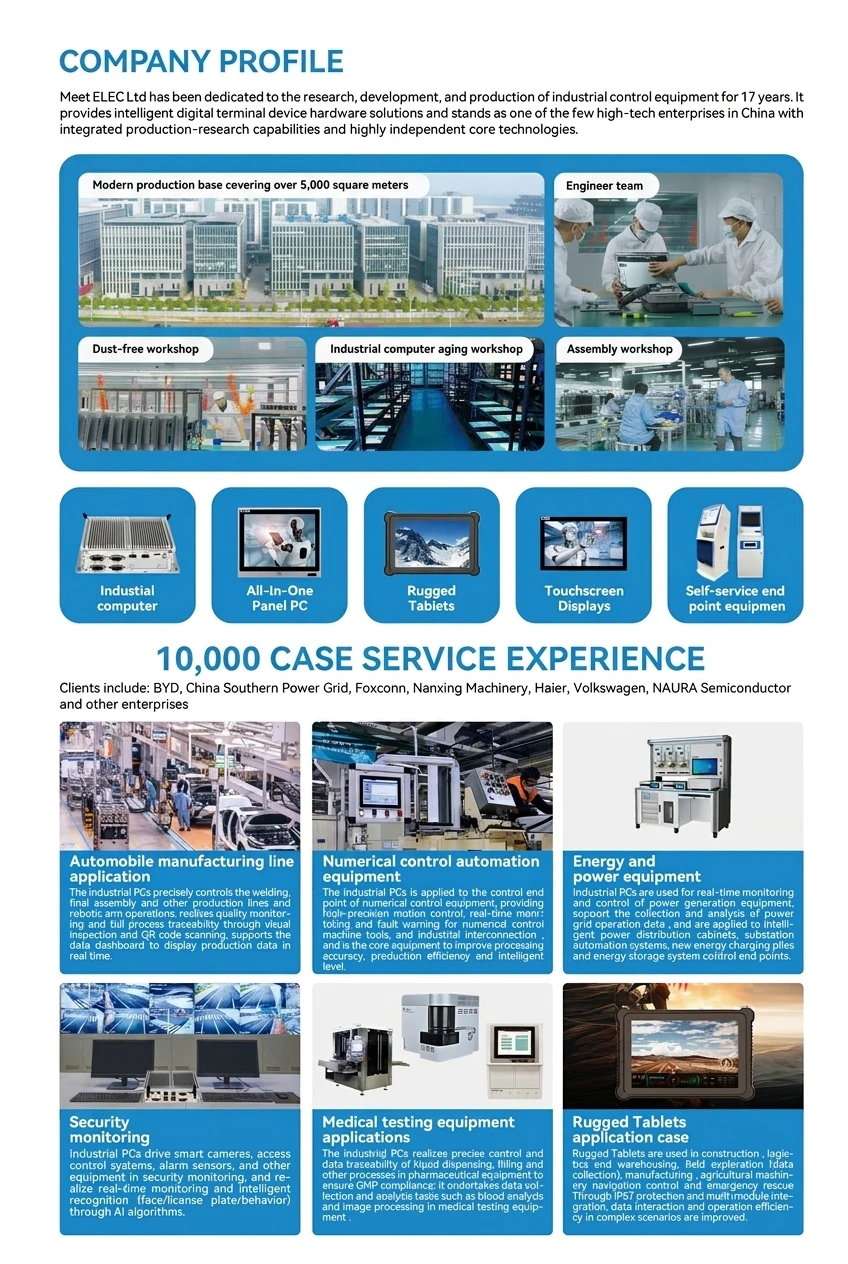
Meetneng (Foshan Lineng Electronic Equipment Co., Ltd.) is an industrial computing manufacturer based in Shunde, Foshan, Guangdong, China. Founded in 2008, the company designs, builds and supports industrial panel PCs, fanless industrial PCs, embedded computers, rackmount servers, industrial displays and rugged tablets for automation projects worldwide.
Our 5,000 m² production base runs an ISO 9001 quality system with a 12-step inspection process covering incoming components, assembly, burn-in, function testing and final packing. Units are built from globally sourced components, and our field repair rate is kept below 0.5%.
OEM and ODM are core to how we work rather than an add-on service. Our engineering team adjusts display size, processor platform, memory and storage, interface layout, enclosure structure, operating system image and branding to match a specific machine or project — from a single evaluation unit to series production, with drawings for approval before tooling.
Meetneng products are used in factory automation, smart manufacturing, machine vision, transportation, energy, medical equipment and industrial IoT. Every project is supported by pre-sales configuration advice, testing before shipment, and after-sales remote diagnostics with spare-parts supply.
Meetneng is backed by the Vinwo Electronics Group and employs a 20-plus member R&D team holding more than 30 patents in industrial computer and display design. The 5,000 m² factory follows ISO 9001 with 12 inspection nodes and produces a catalogue of over 1,000 product types, supported by more than 30 certificates covering safety, EMC, environmental compliance and design patents.
Products are exported to more than 100 countries and regions and are in service with over 15,000 customers, including Haier, Gree, BYD, Hikvision, Foxconn and CRRC. That customer base is the reason our configurations are standardized rather than improvised: the same chassis, mounting pattern and BIOS behaviour are already deployed in production environments, so a new project starts from a proven baseline instead of a prototype.
If you are standardizing a plant, retrofitting an existing machine or sourcing a private-label industrial PC, send us the application and peripheral list — we will propose a configuration and a sample schedule.