The Y6-T8 is an 8-inch Android 9 rugged tablet rated IP65 and tested against 1.2 m drops, with 4G LTE, dual-band WiFi, four-constellation GNSS, an 8200 mAh battery and an optional 1D/2D scan engine. It is built for scanning, inspection and field data collection where a consumer tablet would not survive a single shift.


The Y6-T8 is a compact rugged tablet: an 8-inch Android device in a sealed housing with rubber corner bumpers, rated IP65 against dust and water jets, and tested against a 1.2 m drop onto a composite wood floor. It weighs and handles like a consumer tablet, but it is specified for the temperature swings, vibration and knocks of a workshop, a warehouse aisle or a mine site.
Behind the screen sits a MediaTek MT6761 with 2 GB of RAM and 32 GB of storage, running Android 9. That is an entry-level platform, and it is the right choice for the jobs this tablet is actually bought for: barcode scanning, inspection forms, GIS and map viewing, vehicle checklists, and fixed terminals in a dock. It is not a device for heavy 3D rendering or on-device video analytics — for those, look at our higher-spec rugged models.

IP65 means the enclosure is dust-tight and protected against water jets from any direction — rain, washdown splash and hose spray. Every port sits behind a sealed cover, so the protection holds with the Type-C and SIM doors closed. It is not a submersible device, and it is not certified for explosive atmospheres; if your site needs ATEX or IECEx, tell us and we will quote a different model rather than let you discover the gap during an audit.
The corners carry moulded rubber bumpers and the housing is a rigid composite shell, which is what absorbs the energy in a drop. The unit is tested at 1.2 m onto a composite wood floor — roughly waist height, the most common drop in the field.

The 800 × 1280 panel runs at 350 cd/m² with 7H tempered glass and a G+G capacitive touch layer — two sheets of glass bonded together, which is why it survives glove use, stylus input and the occasional dropped tool better than a film-based touch panel.
Brightness of 350 nits is comfortable indoors and in shade. If the tablet will be mounted on a vehicle dash or used in direct summer sunlight, ask for the anti-glare sunlight-readable panel option; on an open site at noon, the standard panel will look washed out.

2 GB of RAM and 32 GB of storage is enough for one business application, a scanner service and a local cache. It is not enough for ten background apps or a large offline map package plus photo capture. Before you commit to a batch, install your APK on a sample and check two things: the minimum Android API level and the peak memory your app reaches.
Android 9 keeps compatibility with most enterprise apps still in service, and it is the version our MDM and kiosk configurations are validated against. If your software requires Android 11 or later, tell us at enquiry stage.

The 3.7 V / 8200 mAh pack is quoted at 8 hours of 1080p video playback at 50% volume and 200 nits brightness. Real shift use — scanning, screen on and off, 4G active — usually lands in the same range or slightly better, but continuous GPS tracking with the screen on will cut it roughly in half.
Charging is 5 V / 2 A over Type-C. For fleets, the charging dock and the charging expansion dock let you charge without handling cables, which is the difference between a device that gets charged every night and one that does not.

Cellular covers 2G, 3G and 4G LTE for sites without reliable WiFi; the SIM slot is behind the sealed cover next to the TF card. WiFi is dual-band 2.4 GHz and 5.8 GHz, and Bluetooth 4.2 handles scanners, printers and headsets.
Positioning uses GPS, BeiDou, Galileo and GLONASS together, which matters more than the individual constellations: in a yard surrounded by steel racks or containers, four systems give a fix where GPS alone will not. Industrial positioning chips also support base-station and offline positioning for survey and logistics work.

One Type-C port for charging and data, one USB-A port that can be configured as RS-232 for legacy instruments, a 3.5 mm audio jack, a Pogo pin connector for docks, and a combined TF / SIM slot. Side keys cover volume, power and one programmable key that you can map to your own application.
The RS-232 option is the detail that decides most projects: handheld terminals, weighing scales, flow meters and older PLCs still speak serial, and a Type-C-only tablet cannot talk to them without an adapter that breaks in the field.

The base unit does not include a scanner. NFC, RFID, a 1D/2D barcode scan engine and a fingerprint reader are factory options, chosen at order time — they are not field-installable, so specify them up front.
For warehouse and asset-tracking work the usual combination is the 2D scan engine plus NFC; for access control and inspection sign-off, fingerprint plus NFC. Tell us the workflow and we will recommend the module rather than sell you the full list.

A charging dock and a charging expansion dock hold the tablet at a fixed angle and charge through the Pogo pins; a 360-degree ball-head car mount and a standard car mount cover vehicle use; a hand strap, shoulder strap and waterproof carrying case cover field work; a capacitive stylus, HDMI adapter, Type-C OTG cable and DBS9 extension connector cover the bench.
Accessories vary by model and configuration. Send us the mounting position and we will confirm which dock fits — the wrong dock is the most common accessory return on this type of device.

· Industrial manufacturing — line-side terminals, machine set-up and quality checks
· Warehousing and logistics — receiving, put-away, picking and cycle counts with 2D scanning
· Engineering and construction — site inspection, punch lists and drawing access
· Mining — dust and vibration exposure where consumer hardware fails
· Ship and dock — outdoor yard work in rain and salt air
· Surveying and exploration — GNSS positioning with offline maps
· Military and field training — rugged handheld data collection
· Vehicle and fleet use — dash or ball-head mount with 4G backhaul

We build the Y6-T8 to order: memory and storage, optional modules, boot logo and wallpaper, pre-installed APK, kiosk lock-down, packaging and labelling. Minimum order for custom branding is agreed per configuration — single units are available for evaluation before you commit.
The unit can be supplied with CE, FCC and RoHS documentation for the configuration you order. Certification is issued against the exact BOM, because adding a scan engine or a different radio module changes the test scope. Our factory runs an ISO 9001 quality system with 12 inspection points and a repair rate below 0.5%, and Meetneng holds more than 30 patents in industrial computing.
Every tablet is powered on, charged, screen-tested and function-tested before packing. Warranty is one year on the complete unit plus three years on hardware, with a seven-day return window for units that do not match the agreed specification. Stocked configurations ship within 72 hours; customised builds are quoted with a lead time against your BOM.
Item | Specification |
Model | Y6-T8 |
Type | 8-inch Android rugged tablet |
Processor | MediaTek MT6761 |
Memory | 2 GB RAM (other memory options available on request) |
Storage | 32 GB (larger storage available on request) |
Operating system | Android 9 |
Display | 8 inch, 800 × 1280, 350 cd/m², 7H tempered glass, G+G capacitive touch |
Camera | Front 5 MP + rear 8 MP |
Cellular | 2G / 3G / 4G LTE |
WiFi | 2.4 GHz + 5.8 GHz |
Bluetooth | Bluetooth 4.2 |
GNSS | GPS, BeiDou, Galileo, GLONASS |
USB | 1 × Type-C |
Serial | 1 × RS-232 (shared with the USB-A port) |
Other I/O | 1 × audio jack, 1 × Pogo pin, 1 × TF / SIM slot |
Optional modules | NFC, RFID, 1D/2D barcode scanner, fingerprint, 1 × LAN |
Protection | IP65 dust and water resistant |
Drop resistance | 1.2 m drop onto composite wood floor |
Battery | 3.7 V / 8200 mAh |
Endurance | 8 hours (50% volume, 200 nits, 1080p video playback) |
Power input | 5 V / 2 A |
Dimensions | 250 × 166 × 26 mm |
Operating temperature | -20 °C to 60 °C |
Storage temperature | -30 °C to 70 °C |
Humidity | 95% RH, non-condensing |
Colour | Black |
Packing | 1 × tablet, 1 × adapter, 1 × power cable, 1 × manual, 1 × certificate of conformity, 1 × wrist strap |
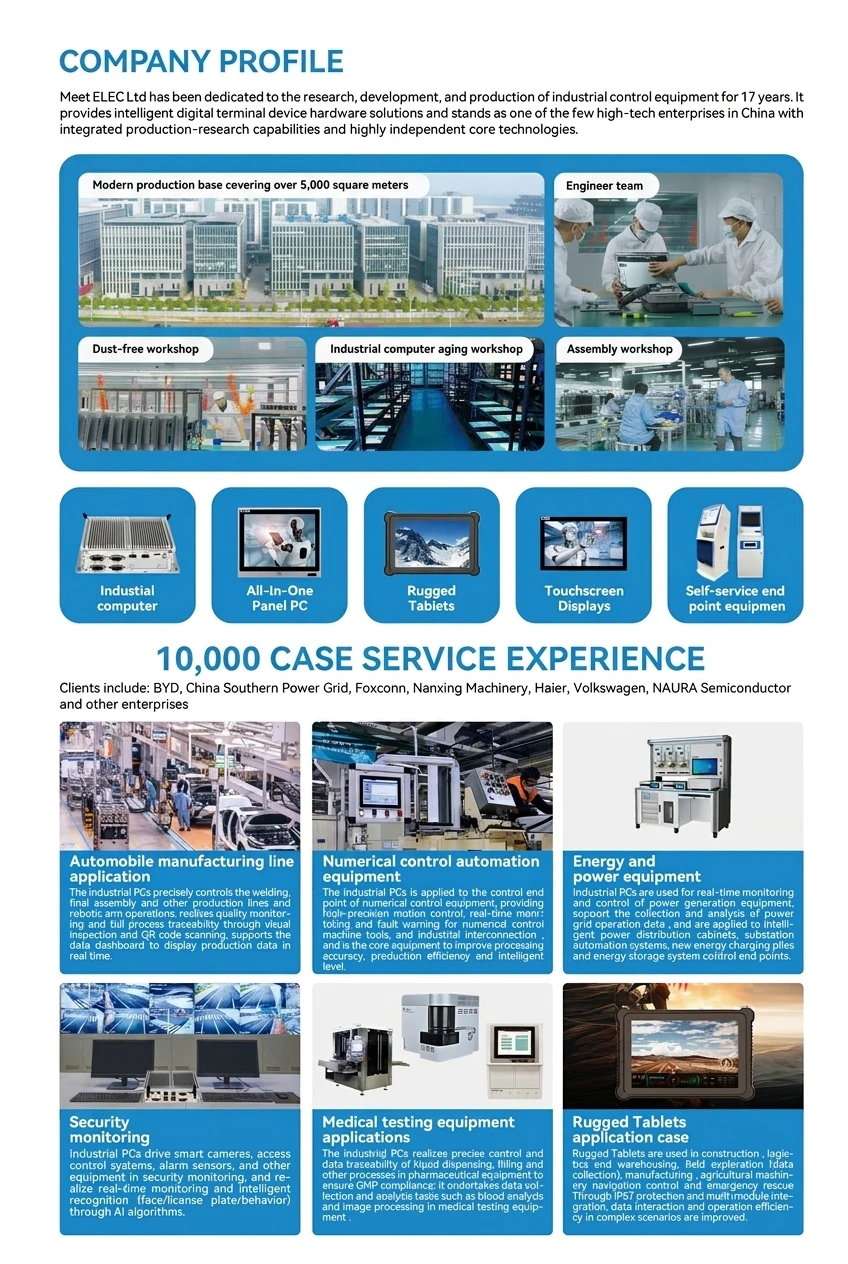
Meetneng (Foshan Lineng Electronic Equipment Co., Ltd.) is an industrial computing manufacturer based in Shunde, Foshan, Guangdong, China. Founded in 2008, the company designs, builds and supports industrial panel PCs, fanless industrial PCs, embedded computers, rackmount servers, industrial displays and rugged tablets for automation projects worldwide.
Our 5,000 m² production base runs an ISO 9001 quality system with a 12-step inspection process covering incoming components, assembly, burn-in, function testing and final packing. Units are built from globally sourced components, and our field repair rate is kept below 0.5%.
OEM and ODM are core to how we work rather than an add-on service. Our engineering team adjusts display size, processor platform, memory and storage, interface layout, enclosure structure, operating system image and branding to match a specific machine or project — from a single evaluation unit to series production, with drawings for approval before tooling.
Meetneng products are used in factory automation, smart manufacturing, machine vision, transportation, energy, medical equipment and industrial IoT. Every project is supported by pre-sales configuration advice, testing before shipment, and after-sales remote diagnostics with spare-parts supply.
Meetneng is backed by the Vinwo Electronics Group and employs a 20-plus member R&D team holding more than 30 patents in industrial computer and display design. The 5,000 m² factory follows ISO 9001 with 12 inspection nodes and produces a catalogue of over 1,000 product types, supported by more than 30 certificates covering safety, EMC, environmental compliance and design patents.
Products are exported to more than 100 countries and regions and are in service with over 15,000 customers, including Haier, Gree, BYD, Hikvision, Foxconn and CRRC. That customer base is the reason our configurations are standardized rather than improvised: the same chassis, mounting pattern and BIOS behaviour are already deployed in production environments, so a new project starts from a proven baseline instead of a prototype.
If you are standardizing a plant, retrofitting an existing machine or sourcing a private-label industrial PC, send us the application and peripheral list — we will propose a configuration and a sample schedule.