
Views: 0 Author: Site Editor Publish Time: 2026-07-24 Origin: Site


The hidden operational cost of miscalculating I/O requirements in industrial deployments surfaces long after installation. Over-specifying inflates hardware budgets unnecessarily, while under-specifying leads to severe network bottlenecks or a dangerous reliance on failure-prone external adapters. Engineering teams constantly struggle to balance the integration of legacy serial equipment with the high-bandwidth demands of modern Ethernet and PoE networks. This challenge is further complicated by strict spatial and thermal constraints inherent in factory floors, remote enclosures, and mobile deployments. Establishing a systematic framework for calculating exact port requirements based on application needs, network topology, and future scalability is essential. By evaluating the specific demands of your edge architecture, you can specify the exact industrial PC I/O ports necessary to ensure reliable, long-term performance without compromising system integrity.
Network Isolation is Mandatory: Separating IT (enterprise) and OT (machine control) networks dictates a baseline requirement of at least two LAN ports for standard industrial deployments.
Native Serial Outperforms Adapters: Native COM ports remain critical for reliable, low-latency communication with legacy PLCs and sensors, avoiding the driver instability and physical failure points of consumer-grade USB-to-serial hubs.
Thermal and Spatial Trade-offs: Adding high-speed LAN or PoE ports increases power draw and heat generation; fanless systems require careful balancing of the available I/O coastline.
Modular Scalability: Opting for systems with modular expansion (PCIe, Mini-PCIe, M.2) provides a safety net against evolving connectivity standards without forcing over-purchasing upfront.
Industrial computers serve as the physical bridge between legacy operational technology (OT) networks and modern information technology (IT) infrastructure. They sit at the edge of the network, ingesting raw data from sensors, programmable logic controllers, and machine vision cameras, processing it locally, and transmitting actionable insights to enterprise servers or cloud platforms. The physical interfaces on these machines dictate how effectively they can perform this bridging function.
Success in edge computing relies heavily on I/O selection. The chosen ports must guarantee deterministic data transfer to maintain precise control over automated processes. They must facilitate seamless protocol translation across disparate industrial standards. Furthermore, the physical hardware must maintain absolute reliability under harsh environmental conditions, including constant vibration, heavy dust ingress, and extreme temperature fluctuations. A misconfigured I/O coastline compromises the entire automated system.
When engineering a solution for the factory floor, you have to look at the exact data pathways. If a machine vision camera drops frames because the Ethernet port cannot handle the throughput, the entire quality assurance line stops. If a legacy PLC loses connection because a consumer-grade USB adapter vibrated loose, production halts. The I/O configuration is not an afterthought; it is the foundation of edge reliability.
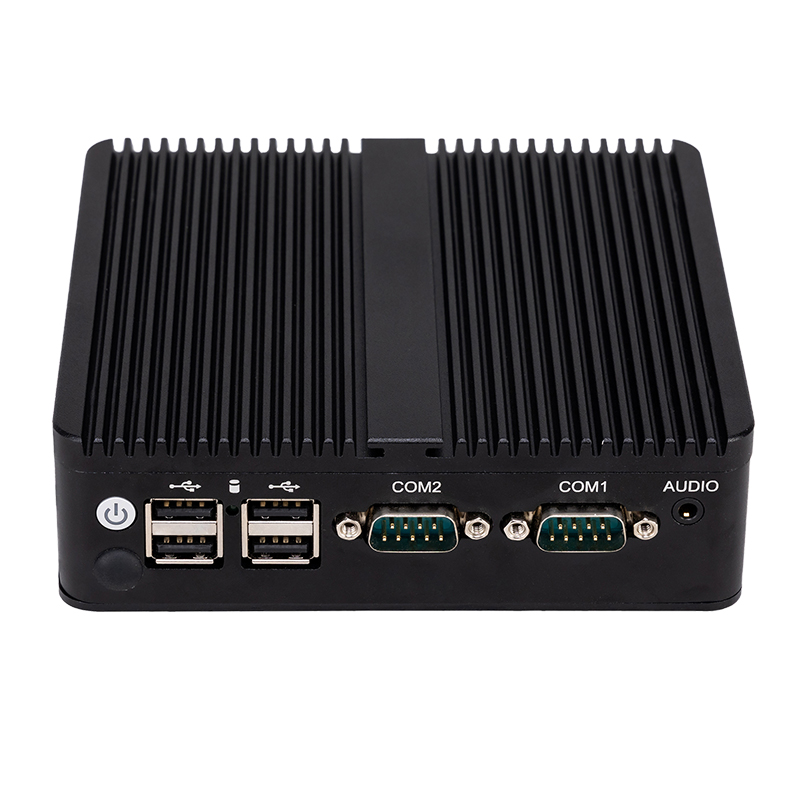
Network segmentation is a fundamental security and operational requirement in modern automation. A multi LAN industrial PC is considered the standard because it allows engineers to physically isolate the control network from the enterprise network. One LAN port handles deterministic protocols like EtherNet/IP, PROFINET, or EtherCAT for real-time machine control. The second port connects to the broader facility network for ERP integration, remote monitoring, and cloud connectivity. This physical separation prevents broadcast storms on the IT network from disrupting time-sensitive OT operations.
Beyond segmentation, multiple LAN ports enable critical redundancy. Implementing failover configurations and link aggregation ensures that if one physical connection or switch fails, the system maintains communication. When selecting these ports, connector durability is paramount. Standard RJ45 ports are suitable for climate-controlled enclosures, but rugged, screw-locking M12 connectors are necessary for high-vibration, washdown, or high-dust environments where standard cables would quickly degrade or disconnect.
Connector Type | Environment | Vibration Resistance | Ingress Protection |
|---|---|---|---|
Standard RJ45 | Climate-controlled cabinets, server rooms | Low | None (IP20) |
Ruggedized RJ45 | Factory floors with moderate dust | Medium | Varies (up to IP54) |
M12 (X-Coded) | Washdown areas, heavy machinery, rail | High (Screw-locking) | IP67 / IP69K |
Advanced edge applications demand rigorous bandwidth calculations. GigE cameras, LiDAR sensors, and high-frequency data logging systems require dedicated, high-throughput connections. Integrating Power over Ethernet (PoE) directly into the system eliminates the need for separate power supplies and reduces cabling complexity. Depending on the peripheral requirements, engineers must specify the correct standard: PoE (802.3af) for basic sensors, PoE+ (802.3at) for standard cameras, or PoE++ (802.3bt) for high-draw devices like PTZ cameras or specialized lighting.
Network speed evaluation is also critical. While 1GbE remains the industry standard, upgrading to 2.5GbE or 10GbE is increasingly necessary for high-resolution, high-framerate machine vision systems. However, physical density limits apply. Packing multiple high-speed Ethernet or PoE ports onto a single 1U, 2U, or ultra-compact fanless chassis generates significant heat. Engineers must calculate whether the system's heat-sinking capabilities can handle the thermal load before the processor is forced to throttle performance.
Audit all connected IP devices and calculate total required bandwidth.
Determine the power draw (in watts) for every PoE device on the network.
Verify the industrial computer's internal power supply can handle the aggregated PoE load.
Select the appropriate connector type (RJ45 or M12) based on environmental exposure.
Despite the proliferation of Ethernet, legacy serial communication remains deeply entrenched in industrial automation. An RS232 industrial computer provides direct, point-to-point control for a vast array of peripherals. Equipment such as barcode scanners, industrial scales, legacy CNC machines, and basic Human-Machine Interfaces (HMIs) strictly require RS-232 connections for reliable operation.
Understanding physical pinout form factors is necessary for proper integration. Serial cables typically utilize DB9 or DB25 male connectors, each with specific standard pinouts for voltage signaling and data transmission. Native 9-pin or 25-pin COM ports equipped with locking thumbscrews are vastly superior to consumer-grade USB-to-serial adapters. Adapters introduce driver instability, latency, and physical failure points that cannot withstand the vibration and shock common in factory environments.
For applications requiring long-distance communication or multi-device networking, different serial protocols are required. An RS485 embedded PC supports two-wire, half-duplex, multi-point communication, allowing engineers to daisy-chain up to 32 nodes over distances reaching 4000 feet. This topology is highly resilient in high-EMI environments. RS-422 offers a four-wire, full-duplex alternative for point-to-point or multi-drop setups requiring simultaneous data transmission and reception.
Modern industrial systems often feature software-selectable COM ports configured directly via the BIOS, allowing a single physical port to switch between RS-232, RS-422, and RS-485 modes. This eliminates the need to open the chassis and adjust manual hardware jumpers, significantly speeding up deployment and field maintenance. In environments prone to voltage spikes and ground loops, specifying optically isolated COM ports is crucial to protect the motherboard from catastrophic electrical damage.
Protocol | Wiring | Communication Mode | Max Distance | Max Nodes |
|---|---|---|---|---|
RS-232 | 3-wire (Tx, Rx, GND) | Full-Duplex | 50 ft (15m) | 1 (Point-to-Point) |
RS-422 | 4-wire | Full-Duplex | 4000 ft (1200m) | 10 (Multi-drop) |
RS-485 | 2-wire | Half-Duplex | 4000 ft (1200m) | 32 (Multi-point) |
USB strategy requires balancing high-speed data transfer with physical security. USB 3.2 Gen 2 ports are necessary for modern peripherals and rapid external storage access. However, unsecured USB ports present a significant cybersecurity risk on the factory floor. Physical port blockers or BIOS-level disabling should be considered for unused interfaces. The integration of USB-C and Thunderbolt is gaining traction, offering unified display, power delivery, and high-speed external I/O expansion, provided they utilize rugged, screw-locking connectors.
Display selection depends entirely on the deployment scenario. DisplayPort and HDMI are standard for modern high-resolution industrial monitors, while legacy VGA and DVI-D are often retained to support older control room screens. Conversely, many edge deployments are entirely headless, requiring no physical display outputs, which frees up valuable I/O coastline for other critical connections.
Digital Input/Output (DIO) or General Purpose Input/Output (GPIO) interfaces provide low-level hardware control. Utilizing isolated industrial gateway ports allows the system to execute direct relay control, trigger physical alarms, and perform simple sensor monitoring. This direct hardware interaction bypasses the need to route basic logic through a dedicated programmable logic controller, simplifying the architecture and reducing latency for critical local responses.
Supervisory Control and Data Acquisition (SCADA) systems acting as data aggregators require a specific I/O profile. A standard PLC communication computer typically demands two LAN ports for network segmentation, two to four COM ports for legacy device polling, and at least one Fieldbus expansion module to interface with proprietary networks like CANopen or PROFIBUS.
Systems dedicated to artificial intelligence inference and automated optical inspection prioritize massive bandwidth and power delivery. The standard configuration for these controllers includes four to eight PoE LAN ports to drive multiple high-resolution cameras simultaneously. They require dedicated USB 3.2 controllers to prevent bandwidth bottlenecking across multiple sensors, and often feature minimal to zero COM ports, as legacy serial data is irrelevant to the visual processing workload.
In-vehicle deployments and remote mobile gateways face unique connectivity challenges. These systems require integrated CAN bus interfaces to pull telemetry directly from vehicle diagnostics. Multiple SIM slots and specific antenna cutouts for Wi-Fi, 4G, and 5G cellular connectivity are mandatory. This wireless infrastructure must be paired with standard industrial I/O to interface with local vehicle sensors and tracking modules.
The physical design of an industrial computer dictates its I/O capacity. High-density LAN configurations, particularly those utilizing PoE, generate substantial heat. Continuous serial polling also keeps the processor active, contributing to the thermal load. In fanless, passively cooled systems, the chassis itself acts as the heatsink. Engineers must carefully evaluate how many ports can operate simultaneously at peak load before the thermal envelope is breached, causing the system to throttle down or shut off entirely.
Power budgeting is equally critical. Calculating the total power draw of all connected peripherals ensures the internal power supply can handle peak loads. A system driving four PoE+ cameras will draw significantly more power than a standard gateway. Failing to account for this peripheral power draw will lead to system instability and unexpected reboots during critical operations.
Selecting between fixed motherboard I/O and modular expansion defines the system's lifecycle. Fixed I/O designs offer a lower upfront cost and a smaller physical footprint, making them ideal for static, well-defined applications. However, they offer zero flexibility if project requirements change. Modular expansion bays utilizing PCIe, Mini-PCIe, or M.2 slots provide essential future-proofing, allowing engineers to add new communication standards as facility infrastructure evolves.
Proprietary modular I/O technologies allow engineers to customize the coastline without expanding the physical chassis footprint. Utilizing customizable bracket punch-outs or specialized expansion modules lets you add specific serial or LAN ports on-demand. Over-specifying fixed ports increases upfront costs, while under-specifying forces reliance on non-rugged external hubs that compromise the system's environmental ratings and physical integrity.
Audit all existing legacy peripherals to determine the exact count and protocol (RS-232/422/485) of required COM ports.
Calculate the maximum bandwidth and power draw for all IP-based devices to size your LAN and PoE requirements accurately.
Select a chassis with modular expansion capabilities to accommodate future network nodes without replacing the entire system.
Verify the thermal dissipation limits of the chosen hardware against the ambient temperature of your deployment environment.
Don't guess and risk downtime. MeetNeng's technical engineers can customize the exact LAN, PoE, and COM ports (including optional optical isolation) for your fanless systems.
A: RS-232 is a standard for point-to-point communication over short distances up to 50 feet. RS-422 supports four-wire, full-duplex communication for multi-drop setups. RS-485 utilizes two wires for half-duplex communication, allowing up to 32 devices to be daisy-chained over distances up to 4000 feet in high-noise environments.
A: Legacy COM ports provide direct, low-latency hardware control that is highly deterministic. They utilize rugged locking connectors that withstand vibration. USB relies on software drivers that can crash, and consumer USB connectors easily vibrate loose, making them unsuitable for critical machine control.
A: Yes, if the PC features modular expansion slots such as PCIe, Mini-PCIe, or proprietary modular I/O bays. If the system only has fixed motherboard I/O and no expansion slots, you cannot internally add more ports and would have to rely on external switches.
A: Specify M12 connectors when deploying equipment in environments subject to heavy vibration, moisture, dust, or frequent washdowns. The screw-locking mechanism of an M12 connector ensures an IP-rated seal and prevents the cable from disconnecting under physical stress.
A: No. USB-to-serial adapters are generally consumer-grade. They introduce latency, rely on unstable software drivers, and lack the physical locking mechanisms required to survive industrial vibration, making them a frequent point of failure in automated systems.


